A craftsman’s approach to historic timber on façades — Part 2 of 4
There is a moment in every timber restoration project where you have to make a decision that nobody else can make for you.
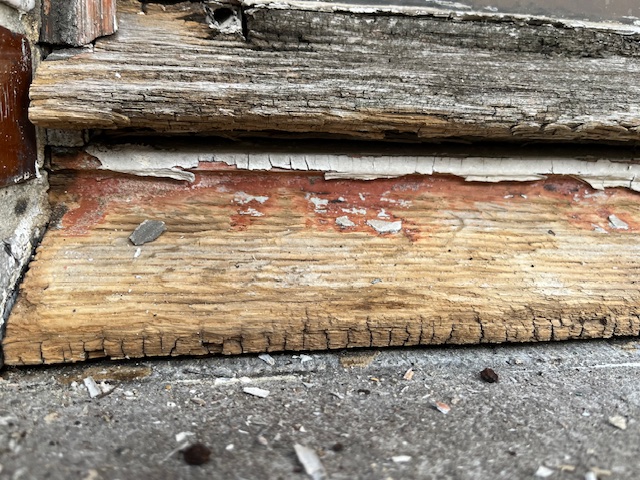
The wood is exposed. The paint is gone. And what you’re looking at is damage — sometimes superficial, sometimes serious. The question is: do you repair it, or do you replace it?
This question has become more complicated in recent years. Social media has filled up with videos of craftspeople performing what look like miraculous saves — rotted window corners rebuilt with epoxy resin, crumbling sills restored to apparent perfection. The technique has its advocates and its results can look impressive.
I want to talk about where I stand on this. Not to dismiss the approach entirely, but to be honest about what I believe — and to invite the Guild to push back if they see it differently.
The epoxy question
Epoxy resin repair systems for timber have genuinely improved. The better products are flexible enough to move with the wood through seasonal expansion and contraction, bond well to prepared surfaces, and can be shaped and sanded to match the original profile.
They are — let me be fair — a significant improvement on the polyester fillers that were widely used in earlier decades. Polyester is rigid. It doesn’t move. The wood around it does. The result, eventually, is cracking at the boundary and moisture ingress at exactly the point you were trying to protect.
Epoxy is better. But better than polyester is not the same as good.
Here is my honest position: I don’t believe in epoxy repairs beyond approximately 5 centimetres.
For small voids, cracks, and surface defects — the kind of thing that inevitably remains even after careful restoration — a quality filler has its place. No timber surface is perfect, and trying to achieve perfection with solid wood replacement on every small imperfection is neither practical nor necessary.
But when the damage extends deeper — when you’re looking at a significant section of rotted end grain, a structural corner that has lost its integrity, a sill that has been failing for years — I believe in removing that section and replacing it with the same species of wood. Scarfed in properly. Primed on all faces before installation. Treated as the craftsman’s responsibility rather than the filler’s problem to solve.
Let’s be clear about one thing: doors and windows are constructed from rails and stiles. There are always very fine seams where they meet—this is normal, and they exist to accommodate the relative movement between the stile and the rail. Wood moves, but it moves differently along the grain than across it. So, deliberately routing out these seams and filling them is simply foolish! That kind of fix never lasts, and it certainly should not be done on historic windows or doors!
The case for original windows
Before we talk about repair techniques, it’s worth saying something that gets overlooked in the rush to modernise: the instinct to save an original window rather than replace it is already a significant statement.
There are craftspeople working today — and you’ll find them if you look — who specialise in exactly this. Draught-proofing, re-glazing, repairing sashes, rebuilding deteriorated sections. The thermal performance of a well-maintained original timber window, properly draught-proofed, is closer to modern alternatives than the replacement industry would have you believe.
And the original window, restored, retains something that cannot be replicated: the profile, the glass, the proportion, the material quality of timber that was old-growth when it was milled.
That deserves respect before it deserves a skip.
The timber quality problem
When you do need to replace a section — or an entire element — you face a question that rarely gets discussed openly.
Is the timber available today equivalent to what was used originally?
In my experience: often not.
Historic joinery was frequently made from slow-grown timber — oak, pitch pine, European redwood selected for its density and resin content. The growth rings are tight. The natural durability is high. Cut a section from an original 19th century window frameand compare it with modern equivalents of nominally the same species, and the difference is sometimes visible to the naked eye.
This doesn’t mean good timber isn’t available. It means you have to look for it, specify it properly, and not accept the first option that arrives on a pallet.
The repair is only as good as the material you’re repairing with.
A question to the Guild
Where do you draw the line on epoxy repair? Have you found systems that genuinely perform over time on historic exterior joinery?
And when you replace sections with new timber — how do you source material that matches the quality of the original?
Original timber, carefully repaired, is always preferable to a perfect-looking replacement. But only if the repair is honest about what it can and can’t do.
RestoreFacade Guild — Part 2 of 4 in the series: Wood on the Historic Façade.