A personal story and an open question to the Guild
There’s a technique that’s been showing up more and more in restoration circles lately —
tuckpointing. Clean lines, sharp results, unmistakably precise. If you’ve seen it done
well, you understand why people are talking about it.
But the first time I came across something similar, it wasn’t called tuckpointing. It was
on a façade I owned myself — a late 19th century house with what we call in Flemish
tradition the “geknipte voeg” — the cut or trimmed joint. And it stopped me in my
tracks.
So where does tuckpointing actually come from?
Tuckpointing originated in England in the late 18th century. The idea was clever and
economical: instead of using expensive, perfectly matched brickwork, you’d lay cheaper
brick and mix your mortar to closely match the colour of the stone. Then, while the
mortar was still workable, you’d press or “tuck” a thin raised line — usually white or
cream — right into the centre of the joint.
The result? From a distance, it looks like immaculate, razor-thin jointing on perfectly
uniform brick. Up close, it’s a craftsman’s trick — and a very skilled one at that.
The technique was originally called “tuck and pat”, evolved into “tuck and point
jointing”, and eventually became simply tuckpointing. It spread across Britain and
beyond during the Georgian and Victorian eras, when the appearance of quality
mattered as much as quality itself.
And the Flemish “geknipte voeg”?
Here’s where it gets interesting — and personal.
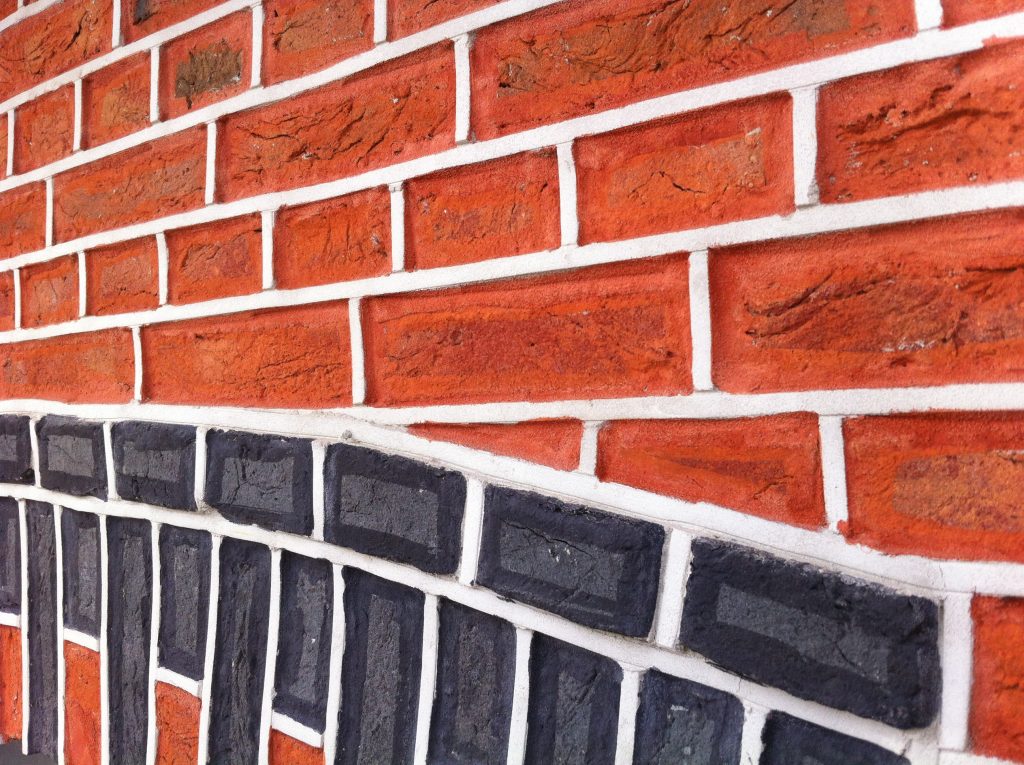
The house I owned had its front façade finished with the geknipte voeg, almost
certainly applied around 1890–1910. The process, as I understood it, went like this:
The mortar was applied fairly dry and deliberately thick. Then, using a long straightedge
and a sharp jointing iron, the horizontal joints were cut — clean and precise. The
vertical (perpend) joints followed. Once the mortar had set to just the right firmness,
each individual brick was carefully colour-matched using a mineral-based coating —
not to paint the whole brick, but to blend any variation in tone so the overall surface read
as uniform.
The result was a façade of quiet precision. Not flashy, but deeply satisfying if you knew
what you were looking at.
Brothers in spirit
Tuckpointing and the geknipte voeg are not the same technique — but they come from
the same instinct: the desire to achieve a refined, controlled finish on a masonry
façade. Both peaked in roughly the same era. Both require patience, skill, and a good
eye. And both are now rare enough that finding someone who truly understands them is
half the battle.
I found my craftsman almost by accident — through a company that came to work on my
side walls. They happened to have someone on their team who knew the geknipte
voeg. That kind of knowledge doesn’t advertise itself. It travels quietly, person to
person.
Why does this matter today?
These techniques aren’t just historical curiosities. There are thousands of façades
across Belgium, the Netherlands, France, and the UK that were originally finished this
way. When those joints deteriorate — and they do — the question is not just how do you
repair them, but do you even recognise what you’re looking at?
Pointing them over with standard mortar isn’t restoration. It’s erasure.
My question to the Guild
know demand for these finishes is limited. The cost alone — easily three times that of
standard repointing — puts most clients off. But that doesn’t mean the knowledge
should disappear.
Has anyone here worked with tuckpointing or the geknipte voeg?
Have you
encountered it on a project? Restored it? Tried to source the right materials or find
someone who still knows the method?
I’d genuinely like to hear from you — whether you’ve done it once or built a career
around it. This is exactly the kind of knowledge the Guild exists to keep alive.
RestoreFacade Guild — connecting the craftspeople who remember how it was done.