Part of the series: Joints, Mortar and the Art of Repointing Historic Facades
In the previous post in this series, we looked at mortar — what goes into it, what to leave out, and why getting the mix right is the foundation of everything that follows. If you haven’t read it yet, it’s worth starting there.
Now we get to the joint itself. What it looks like, how it’s made, and — before we get to any of that — one mistake that undermines good repointing work more often than almost anything else.
The first decision — how do you remove the old mortar?
Before a single trowel of new mortar goes into a joint, the old mortar has to come out. And the way that removal is carried out determines the quality of everything that follows.
The standard approach on many repointing jobs — particularly commercial work where speed matters more than quality — is a diamond-tipped angle grinder. Fast, efficient, and capable of removing mortar to a consistent depth across a large area in a short time. On new construction with regular, wide joints, it can be an appropriate tool.
On a historic facade, it is frequently the wrong choice. And the consequences of using it wrongly are irreversible.
The problem is simple:
— a standard diamond disc — typically 8 to 10 millimetres wide — cuts a slot that is fixed in width. If the joint it is cutting is narrower than the disc, or if the disc wanders even slightly, it cuts into the brick face. That damage cannot be undone. The brick face is gone.
Historic brickwork — particularly from the 18th and 19th centuries — was often laid with relatively narrow joints. The stootvoegen, or perpend joints, between bricks in a single course can be narrow enough that a standard diamond disc simply cannot be used without damaging the surrounding masonry.
The better approach: chiselling out.
Hand tools — plugging chisels, cape chisels, the appropriate hammer — allow the craftsperson to work carefully within the joint, following its shape rather than imposing a fixed width onto it. It is slower. It requires more skill and more attention. And it produces a joint that is clean, properly prepared, and ready to receive new mortar without damage to the surrounding masonry.
For those who need a powered option for efficiency, the market now offers narrow diamond blades — some as thin as 2 millimetres — mounted on oscillating multi-tools such as the Fein MultiMaster. These can be used carefully in narrow joints where a standard grinder would cause damage. They are not as precise as hand tools, but they are a significant improvement over a wide angle grinder used without care.
The rule of thumb is straightforward: if the tool is wider than the joint, it should not be the primary removal method. No craftsperson who understands what they are looking at will reach for a wide diamond disc on a historic facade without first assessing whether it can be used safely. And on many historic buildings, the honest answer is that it cannot.
The joint styles — from most to least common
With the old mortar properly removed and the joint prepared, the question of style can be addressed. What follows is an overview of the main joint profiles used in historic masonry — from the most common to the most specialised.
Tuckpointing and the cut or raised joint
have their own dedicated posts in this series — follow the links if you haven’t read them yet. What follows covers the remaining styles.
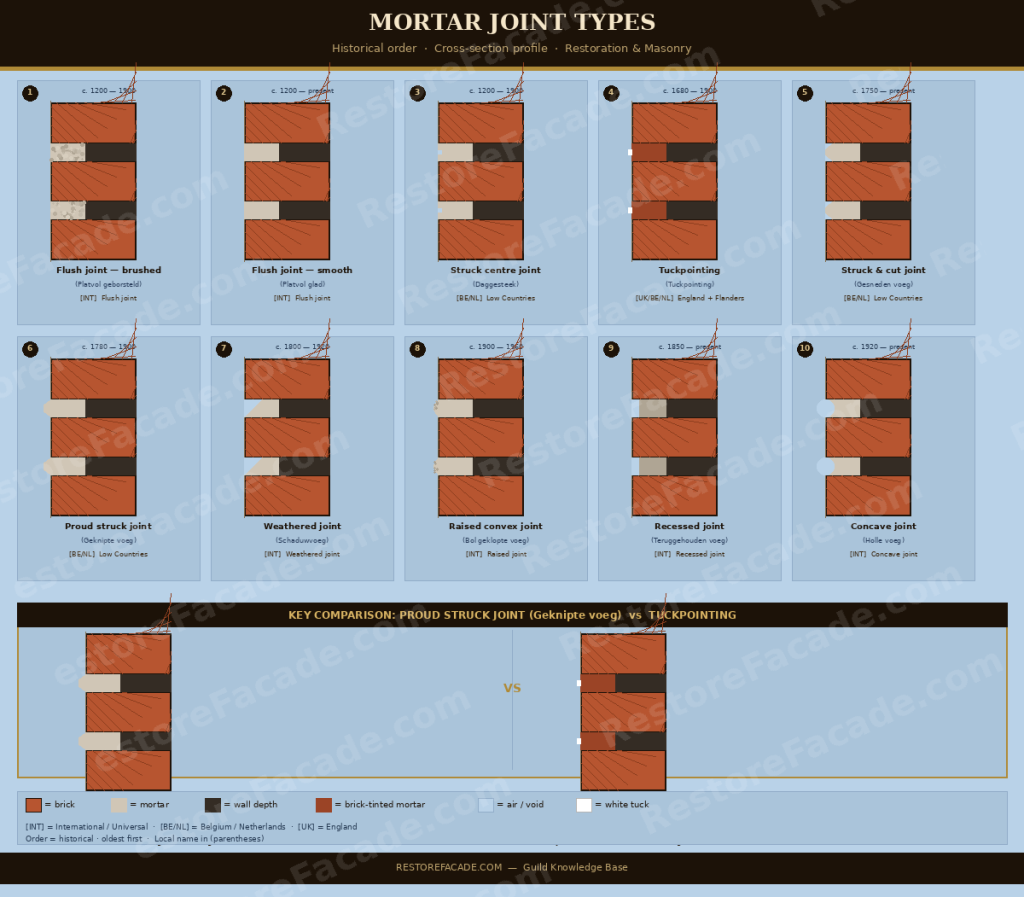
Flush joint (stomp / platvol)
The simplest joint profile — mortar applied flush with the face of the brick, then finished either by striking off cleanly or by brushing/combing the surface while still fresh.
The brushed or combed version (geborstelde / gekamde voeg) has a slightly textured surface that is deliberately less smooth. It is one of the most common choices for its economy — less skill required, less time spent finishing. The texture also makes it easier to conceal any minor variations in fill.
The smooth struck version (gladde platvol voeg) requires the mortar to be pressed firmly into the joint a second time after initial application, producing a denser, smoothersurface. It takes slightly more care but gives a cleaner result.
Both are appropriate for historic facades where a simple, undemonstrative joint is historically consistent. Neither should be used where the original joint profile was something more specific.
Recessed flush joint (glad verdiepte doorgestreken voeg)
A variation on the flush joint where the mortar is struck back slightly — typically 2 to 5 millimetres — behind the face of the brick. The result is a joint that sits behind the masonry surface, creating a subtle shadow line that emphasises the individual bricks.
The depth is limited by the quality and depth of the mortar bed — pushing the joint too far back produces a profile that traps water rather than shedding it, and that does not protect the joint edge of the brick adequately.
This joint style is a reasonable choice on many historic facades and has some historical precedent. It should not be confused with the more dramatic and deliberately decorative recessed profiles that require specific techniques and materials.
Shadow joint (schaduwvoeg)
In this profile, the horizontal joint is cut at an angle — the upper face of the joint slopes back into the wall, while the lower face remains flush with the brick. The vertical joints are kept flush.
The effect is to create a consistent horizontal shadow line across the facade, emphasising the coursing of the brickwork and giving the wall a strong horizontal reading. It is more common in certain regional traditions than others, and requires consistent execution to work well — an inconsistent angle reads as carelessness rather than intention.
Dagged joint (daggestreek / daggesnede)
A relatively specialised decorative joint, found on certain older buildings and occasionally specified for careful historic restoration. After the mortar has been applied and struck flush, a narrow jointing tool is pressed along the centre of the horizontal joint to create a fine recessed line — a groove within the joint itself.
The effect is subtle — a thin shadow line running along each course — but on the right building it adds a refinement that distinguishes careful work from routine repointing. It can also be applied to the vertical joints, creating a grid pattern across the facade.
This is not a joint for every building or every context. But for craftspeople working on buildings where it appears in the original fabric, knowing how to execute it correctly is part of doing the job properly.
Hollow joint (holvoeg)
A concave profile, produced by drawing a curved or rounded tool along the fresh mortar to compress and shape the surface into a slight inward curve. The result sheds water effectively — the curved surface directs rainfall down and away from the joint edge — and has a clean, deliberate appearance.
The hollow joint is more commonly associated with new brickwork than with historic restoration, but it appears in certain regional traditions and periods. On buildings where it is original, it should be reproduced faithfully.
What the joint profile is not
One point that applies across all of these styles: the joint profile is a finishing decision, made after the mortar has been properly applied and the joint fully filled. It is not a substitute for thorough filling.
A beautifully finished surface profile on a joint that has not been properly packed is worse than a rough joint that is fully filled. The mortar must reach the back of the joint, bond to both masonry surfaces, and support the brick or stone on both sides before any thought is given to finishing the face.
This sounds obvious. In practice, on large repointing jobs where speed is a factor, the finishing can run ahead of the filling. The result looks right from a distance and fails within a few years.
A question to the Guild
The grinder debate is one that divides craftspeople — some defend the efficiency of power tools for mortar removal, others will only use hand tools on historic work.
Where do you draw the line? Have you encountered historic facades where the joint geometry made power tool removal genuinely impossible? And for those who have used narrow oscillating blades — how do they compare to hand chiselling in practice?
And to property owners reading this:
if you are commissioning repointing work on a historic building, ask the craftsperson how they intend to remove the old mortar before work begins. The answer will tell you a great deal about the quality of the work that follows.
This post is part of the series: Joints, Mortar and the Art of Repointing Historic Facades. Read the previous posts on tuckpointing and the cut joint, and on mortar composition, for the full picture.
RestoreFacade Guild — for the craftspeople who know that the finish is only as good as the preparation underneath it.