A call to craftspeople — and a wake-up call for owners of historic homes
If you’ve worked on historic façades long enough, you already know what I’m about to
say.
You’re standing in front of a beautiful period home. The stonework is suffering. The
render is crumbling. There’s efflorescence creeping down the front, staining everything
below it. The owner wants the façade restored — and rightly so.
But before you touch a single stone, you look up.
And there it is. The zinc gutter. Neglected, patched — a few flaps of roofing felt torched
over the worst spots by a roofer who came by on a ladder or a cherry picker, spent an hour, or so, on it, and called it done.
Still technically “holding”. Still technically “not leaking” — at least not visibly, not yet.
That gutter is where the real story begins.
The damage nobody sees coming
Water is patient. It doesn’t announce itself. It finds the smallest gap and quietly begins
its work — frost, saturation, salt crystallisation, cycle after cycle — long before anything
shows on the surface.
By the time a homeowner notices the damage on their façade, the gutter has often been
failing for years. Slowly. Invisibly.
And here’s the part that rarely gets said out loud: the roofing felt that was supposed
to fix it is often making things worse.
Roofing felt over zinc – a fix that isn’t
Let’s be honest about what happens in practice.
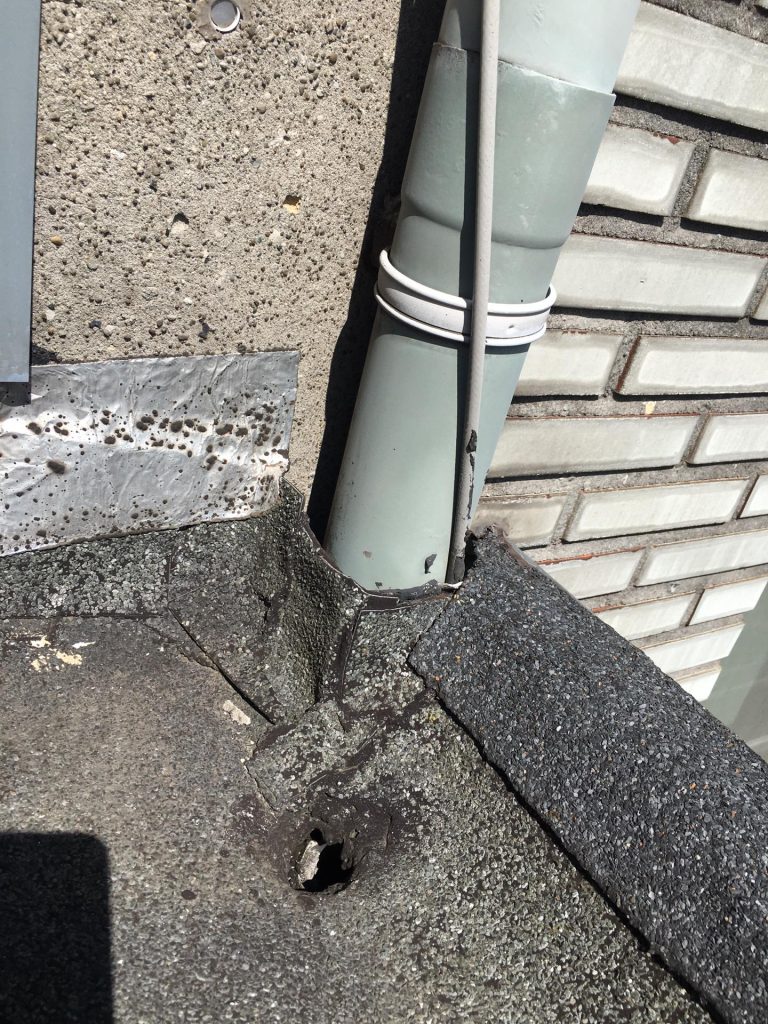
The zinc gutter shows signs of corrosion. The homeowner calls someone — usually a
roofer, because that’s who comes to mind for “roof problems”. The roofer arrives with a
ladder or a cherry picker, torches a few flaps of roofing felt over the corroded areas, and
the job is done in under an hour.
It looks sealed. It feels resolved. The invoice is manageable.
But roofing felt applied over deteriorating zinc is not a repair. It traps moisture
underneath, accelerates the corrosion it was meant to stop, and creates new problems
at every edge where the felt meets the original material.
And then there’s the drain outlet — the taphole. That small but critical point where the
gutter releases water into the downpipe. By the time someone is patching the gutter
with felt, the outlet fitting is almost certainly already leaking. Slowly. At the joint. Every
time it rains.
Nobody sees it. Nobody addresses it. And the water quietly finds its way into the wall.
It’s the small seams that betray you
This is what experienced zinc workers understand and most others don’t: zinc gutters
don’t usually fail in one dramatic moment. They fail at the seams. The small, tight
folds where two sheets meet. The soldered joints that have been expanding and
contracting through decades of summers and winters until the bond finally gives — just
slightly, just enough.
A hairline gap in a gutter seam, running water every time it rains, season after season.
That’s all it takes.
By the time the façade shows the damage, you’re not looking at a gutter problem
anymore. You’re looking at saturated masonry, potentially damaged structure, and a
restoration project that has grown considerably beyond what anyone budgeted for.
The cascade nobody budgets for
Once water has penetrated behind a historic façade, you are no longer dealing with one
problem. You are dealing with several, simultaneously:
*The zinc work needs to be properly renewed first — otherwise any façade repair is
pointless
*The masonry may need repointing, cleaning, or partial rebuilding
*Interior damage may have occurred — plaster, woodwork, structure
*Steel I beams starts corroding
*Painted or rendered surfaces need to come last
That means coordinating multiple specialists. A zinc worker. A stone restorer. Possibly a
carpenter. Possibly a plasterer. All working in sequence, on a scaffold that costs money
every day it stands.
For a large monument, a major contractor can manage this. They have the teams, the
planning, the resources.
But what about the owner of a historic townhouse? A period villa? A century-old family
home that deserves proper care?
Those owners are largely on their own. Large contractors aren’t interested. General
builders don’t have the knowledge. And finding the right specialists — separately, in the
right order, at the right time — is a project in itself.
This is exactly why RestoreFacade exists. But that’s a conversation for another day.
A message to craftspeople
If you’re a zinc worker reading this, I want to say something directly:
Your work is the first line of defence for everything below it. The gutter you restore
properly today is the façade that doesn’t need emergency intervention in ten years.
Help your clients understand that a proper zinc repair — done by the right person, at the
right time — is an investment, not an expense. Not to sell them something they don’t
need. But because it’s true, and because most of them genuinely don’t know the
difference between a real repair and a temporary patch.
A message to homeowners
If you own a historic home, ask yourself honestly: what’s happening at the top of your
façade right now?
When were your zinc gutters last properly inspected — not patched, not felt-over, but
actually looked at by a zinc worker who knows what they’re doing? Is the drain outlet still
sealing properly? Are the seams still sound?
A proper repair, done at the right time, costs a fraction of what follows when it’s left too
long.
The damage always starts where nobody looks. At the top. At the seam. At the tap hole
that’s been weeping quietly for three winters.
Invest there first. Everything below it will thank you.
Have you encountered this on your projects — as a craftsperson or as a homeowner?
What did you find when you looked closely at the gutters? The Guild wants to hear your
experience.
RestoreFacade Guild — because the right repair, done by the right person, at the right
time, changes everything.