Part 4 of 5: The Ceramic, Glass and Mosaic Series
When people think of glass on a historic facade, they think of windows. The glazed opening, the sash or casement frame, the relationship between solid wall and transparent void that gives a facade its rhythm and character.
But glass has appeared on historic facades in ways that have nothing to do with windows. As a surface material. As decoration. As colour. As a substitute for stone or ceramic in locations where its particular properties — reflectivity, translucency, colour depth — offered something that no other material could provide.
This post is about that other glass. The glass that is not in the windows but on the wall.
The tradition of architectural glass
The use of glass as an architectural surface material — as opposed to a transparent infill in an opening — has a longer history than most people realise.
Mirrored glass appeared in Islamic architecture from the medieval period onward. The interiors of Persian and Mughal buildings were decorated with small mirror fragments set into plasterwork — āina-kāri in Persian — creating surfaces that multiplied light and created spatial effects of great complexity. This tradition spread across the Islamic world and eventually influenced European decorative practice.
Glass paste and vitreous enamel — glass fused to a metal or ceramic substrate to create coloured decorative elements — appeared in European goldsmithing and later in architectural contexts from the medieval period onward. The cloisonné and champlevé enamels of medieval metalwork used essentially the same technology as architectural glass paste.
Verre églomisé — glass with decoration applied to the reverse face, protected by a backing — was used for decorative panels, mirrors, and small architectural elements from the Renaissance onward. The characteristic gold and coloured reverse-paintedglass of 18th and 19th century interiors is the most familiar form of this technique.
Glass on the Art Nouveau facade
It is in the Art Nouveau period that decorative glass became a significant element of facade design — not as an occasional accent but as a considered part of the architectural vocabulary.
The connection between Art Nouveau and glass is well understood in the context of interiors: the stained glass of Tiffany, the pâte de verre of Gallé, the extraordinary glazed volumes of Victor Horta’s interiors. What is less often discussed is the use of glass on the exterior facade itself.
On the most ambitious Art Nouveau facades, glass appeared in several forms.
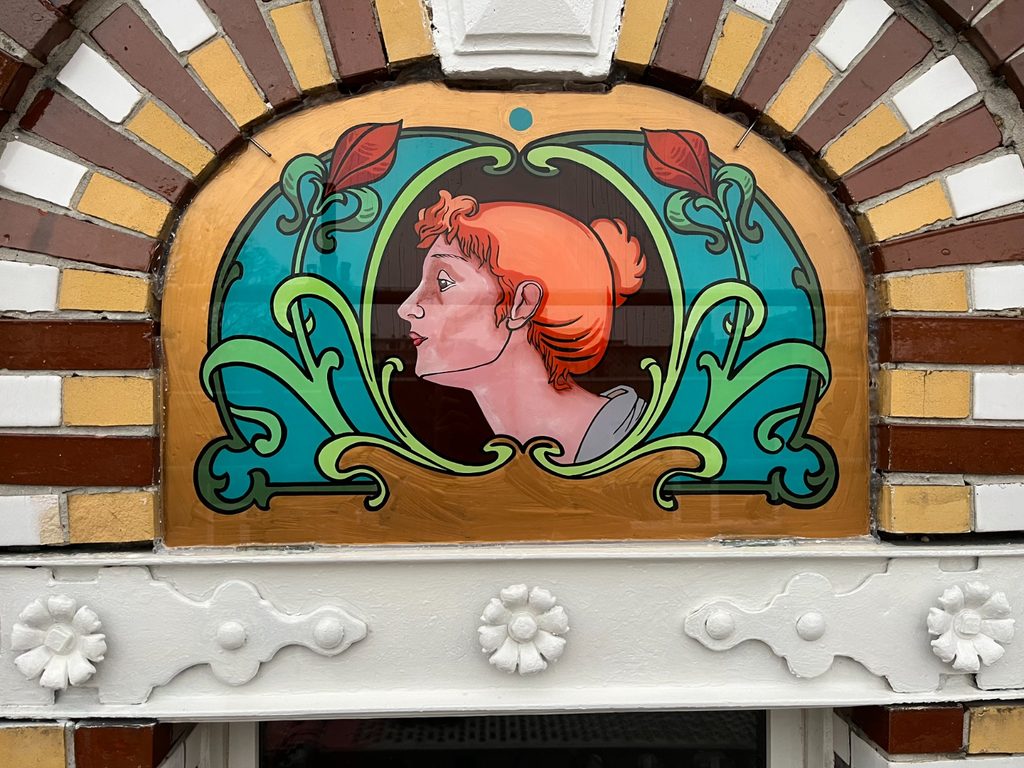
Painted glass panels — set into the masonry of the facade rather than into window openings — provided colour and visual richness at locations where neither ceramic nor stone could achieve the same effect. The translucency of glass, even when not backlit, gives depth to a coloured surface that opaque materials cannot replicate.
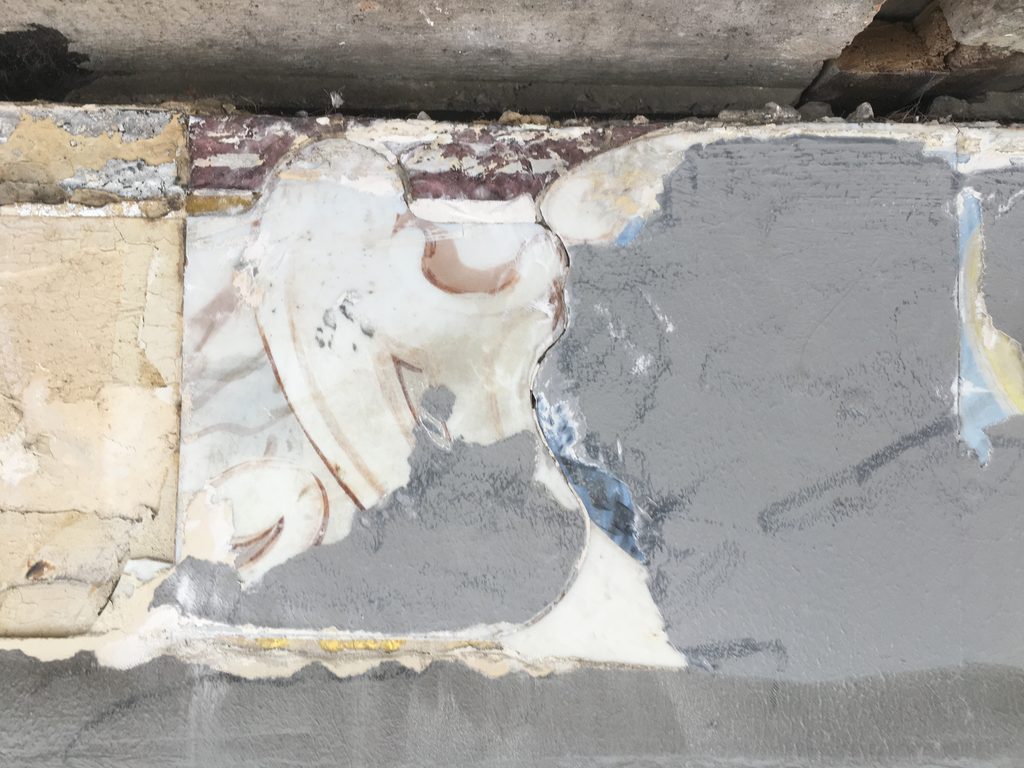
Oversized decorative glass panels painted directly also appear on some facades — glass surfaces painted with decorative motifs, sometimes in multiple colour bands, set into the wall as architectural decoration. At Stenenbrug 99 in Antwerp, small glass panels of this type survive — painted with decorative motifs on one section, and with an ugly later grey band on another, applied during a period when the original intention was no longer understood or valued. These oversized panels illustrate both the ambition of the original design and the damage that well-intentioned but uninformed later interventions can cause.
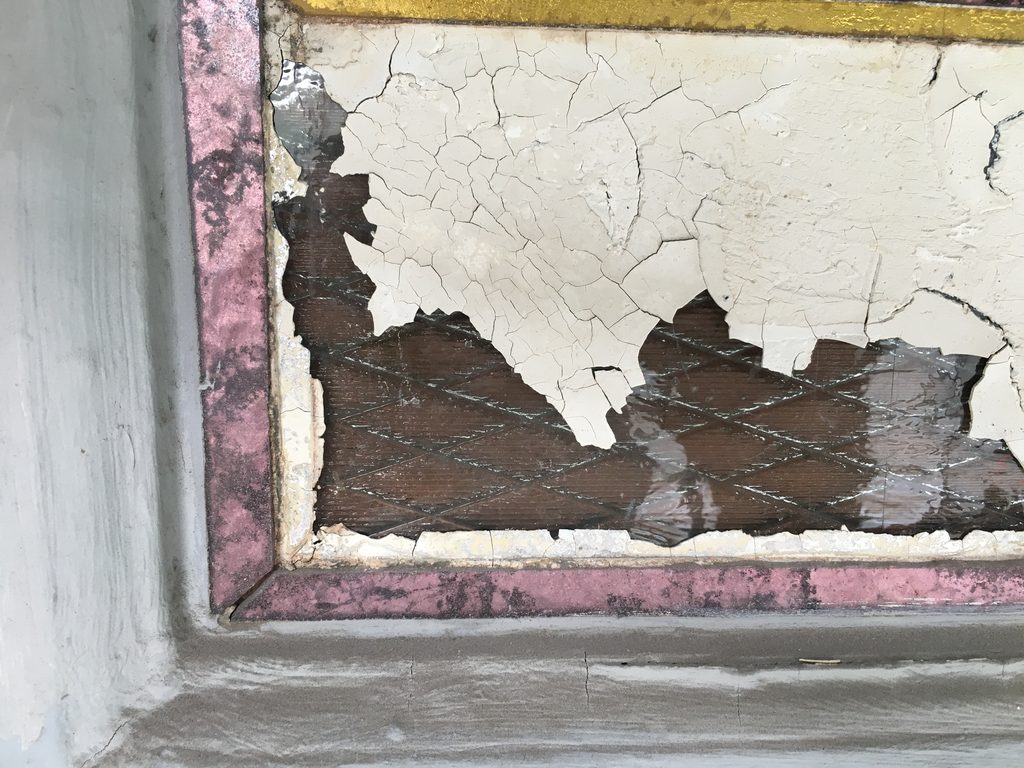
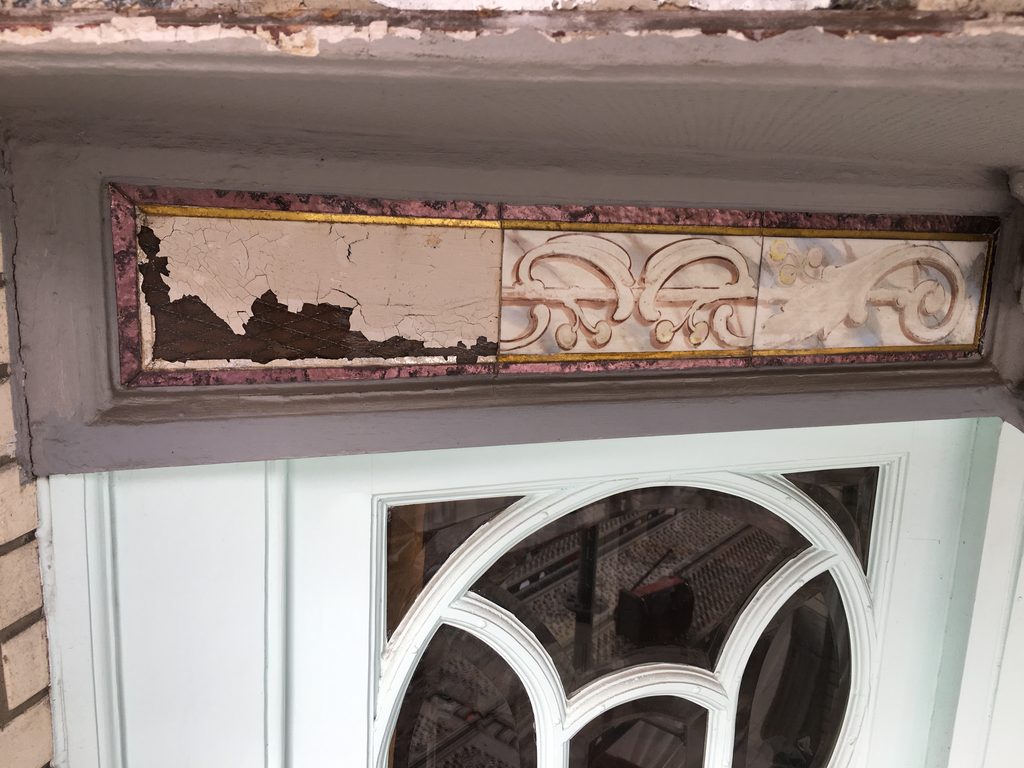
The more elaborate dialogue between ceramic and glass as complementary facade materials appears at Jaak de Braeckeleerstraat 8/10 in Antwerp — where one half of a double house carries mosaic panels beneath the windows while the other carries painted glass panels in mirror-image positions. The compositional relationship between ceramic mosaic and painted glass on two halves of a symmetrical facade is one of the most interesting examples of this material dialogue in Belgian Art Nouveau domestic architecture.
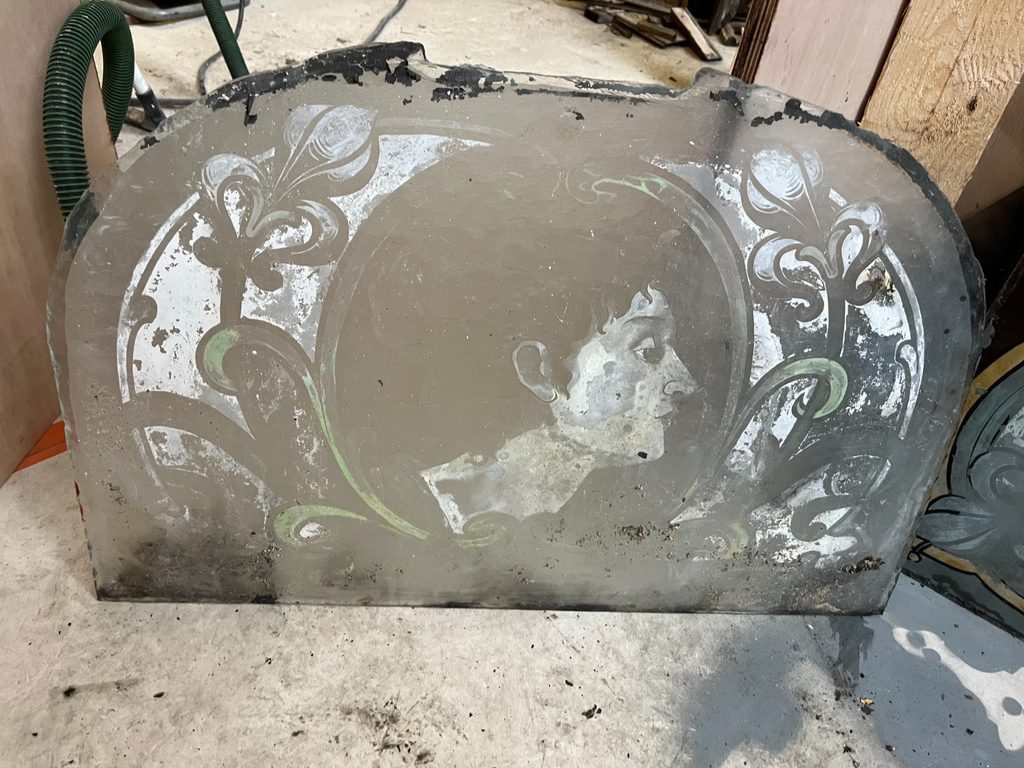
Iridescent glass — glass treated to produce a surface that shifts colour with the viewing angle, developed by Louis Comfort Tiffany and others in the late 19th century — appeared on some Art Nouveau facades as small accent elements. Its shimmering, opalescent quality was exactly suited to the Art Nouveau interest in natural and organic effects.
Mirrored glass elements — small pieces of mirror set into render or ceramic tile surrounds — appear on some Art Nouveau and later facades, creating localised reflective accents.
silver stain and the painted glass tradition
Silver stain — a technique in which a silver compound is painted onto the surface of glass and then fired, causing the silver to penetrate the glass and produce a permanent yellow or amber colour — has been used in stained glass work since the early 14th century. It is one of the fundamental techniques of traditional glass painting, and it requires specific knowledge of how the silver compound behaves during firing, how concentration affects the resulting colour, and how the technique integrates with other glass painting methods.
The question of lead-free silver stain alternatives is one that the glass restoration community is actively working through. Traditional formulations use lead compounds as part of the painting process. Newer lead-free alternatives are available, but their longterm performance in exterior architectural applications is still being established. This is exactly the kind of field question where practitioner experience over time matters morethan laboratory testing.
The Guild has a strong group of glass specialists who work across this territory — Hélène, Pierre, Jonathan, Paulo José, Emmanuelle, Jean, Ellen, Adélie and Gregory bring expertise in painted glass, stained glass, and architectural glazing from France, Portugal, Belgium and beyond. Pierre, a Meilleur Ouvrier de France in glazing, represents the highest level of French craft recognition in this field. Between them, this group holds considerable knowledge of both traditional techniques and current material questions — including the silver stain debate.
How decorative glass was fixed — linseed oil putty and wooden frames
The fixing of decorative glass panels in historic facades is an area that deserves more attention than it typically receives in restoration literature.
The traditional method for setting glass into architectural openings — whether windows or decorative panels — used wooden frames or sashes into which the glass was bedded with linseed oil putty (lijnolie stopverf). The putty, pressed into the rebate of the wooden frame and finished with a neat chamfered face, held the glass firmly while remaining slightly flexible — capable of accommodating the differential thermal movement between glass and timber without cracking or losing adhesion.
Linseed oil putty is itself a sacrificial material. Over time it dries, hardens, shrinks, and eventually cracks and detaches from the glass or the frame. This is not failure — it is the expected behaviour of a material that was designed to be renewed. When putty is maintained — replaced before it fails completely and before water has had the opportunity to penetrate behind it — the glass and the frame beneath it are protected indefinitely.
When putty is not maintained — when it cracks and shrinks and water begins to find its way behind it — the consequences spread rapidly to the timber frame. Wet timber rots. Rotting timber loses its ability to hold the glass securely. And a glass panel that was sound for a century becomes a structural problem in a decade of neglect.
For decorative glass panels set into masonry rather than timber frames, the fixing varied. Lead-camed glass — where individual pieces of glass are held together by Hsection lead strip — was used for decorative facade panels in the same way as for windows. Copper foil technique allowed more intricate shapes. And in some cases, individual glass panels were set directly into lime mortar beds, with the same compatibility and movement considerations as ceramic tesserae.
How decorative glass fails
Lead-camed glass fail through oxidation and fatigue — the lead becomes brittle, came joints crack, panels bow and deform. Restoration requires releading — disassembling the panel, replacing the came, and reassembling with the original glass where it survives.
Copper foil technique fail through solder joint failure and foil corrosion. Restoration typically requires resoldering and may require foil replacement.
Linseed oil putty fails through drying and shrinkage — the solution is replacement with fresh putty before water penetration reaches the timber or masonry behind.
Direct-set glass elements fail through mortar bond failure and differential thermal movement — the same issues as for ceramic tesserae, but with the added complication that glass is more thermally sensitive than most ceramic materials.
The problem of painted decoration under later coatings
One specific situation that restoration workers encounter on historic facades with decorative glass is painted glass panels that have been covered by later paint applications — sometimes decorative, sometimes simply opaque.
At Stenenbrug 99, glass panels with original painted decoration were partially obscured by later grey paint applied during a period when the decorative intent was no longer recognised. The question of how to approach such panels — whether to attempt removal of the later coating, whether the original decoration beneath is still recoverable, and what the risks of intervention are — is one that requires specialist assessment before any action is taken. Painted glass is fragile, and the wrong solvent or the wrong mechanical approach can destroy what it is trying to recover.
The specific problem of inaccessibility
One challenge that applies particularly to decorative glass panels in facade positions — as distinct from windows — is that they are often in locations that make inspection and maintenance difficult.
A window can be opened from inside. A decorative glass panel set into the masonry of the facade cannot. Assessment of its condition from the outside is limited, and access for repair typically requires scaffold or elevated access equipment.
This inaccessibility means that small problems — a cracked piece of glass, a failed solder joint, a loose section of came — are not noticed and addressed when they are still small. By the time they become visible from the street, or by the time water penetration through a failed panel is noticed inside, the damage is typically more extensive than it would have been if the problem had been caught earlier.
Regular inspection — ideally with binoculars a lens from street level, and periodically with close-up access, or a drone even — is the only mitigation. And it is another argument for the principle of planned maintenance rather than reactive repair.
A question to the Guild
The Guild’s glass specialists — Hélène, Pierre, Jonathan, Paulo José, Emmanuelle, Jean, Ellen, Adélie and Gregory — bring a range of experience to these questions. Has anyone in this group worked on decorative facade glass specifically, as distinct from window glazing? The fixing systems, the assessment of painted panels under later coatings, and the question of linseed oil putty renewal on historic timber frames all seem like areas where the group’s combined experience would be valuable.
And more broadly: what is the Guild’s experience of linseed oil putty in practice — its lifespan in different exposure conditions, the indicators that renewal is needed before failure occurs, and the best formulations currently available?
RestoreFacade Guild — for the craftspeople who work with light as well as stone.
Next — and last — in the series: Restoration Today — sourcing, matching, adhesion, and what to do when the original material is no longer available.