A practical guide for craftspeople and owners of historic buildings
Summer is the season when facade cleaning gets planned. The scaffold is up, the weather cooperates, and the building finally looks like it needs attention. Before any cleaning begins — before a single nozzle is pointed at a historic wall — the question that matters most is not “how do we clean it?” but “what are we actually cleaning, and what method will do the least harm?”
This question is not optional. The wrong cleaning method on a historic facade can cause damage that no amount of subsequent restoration will fully reverse. Soft stone eroded by inappropriate abrasive cleaning. Mortar joints opened by water pressure that was too high. Lime render dissolved by acid. Brick faces permanently altered by alkaline treatments that were left too long.
Every method has its place. Every method also has its limits. Understanding both is the difference between cleaning that serves the building and cleaning that harms it.
First — what are you cleaning?
Before choosing a method, the material must be identified. This sounds obvious, and yet it is skipped more often than it should be.
A cleaning method that is appropriate for hard engineering brick is not appropriate for soft handmade brick from the 18th century. A method that works well on granite will damage limestone. A method that removes organic growth from render may dissolve the lime binder in the same operation.
The specific material — its hardness, its porosity, its mineralogy, the nature of the soiling — determines which methods are safe and which are not. When in doubt, test in an inconspicuous location before committing to a full elevation. This is not overcaution. It is basic professional practice.
Water — the gentlest starting point
Water is the most fundamental cleaning agent for historic masonry, and in many cases it is sufficient.
Low-pressure water washing – water applied at low pressure over an extended period, allowing soiling to soften and release — is appropriate for a wide range of historic masonry types and causes minimal risk to sound material. It is particularly effective for general atmospheric soiling and biological growth that has not deeply penetrated the surface.
The key variables are pressure and time. Low pressure — far lower than most people assume is necessary — combined with sufficient dwell time, will shift a surprising amount of soiling without any risk to the underlying material.
High-pressure water washing is a different matter entirely. The pressure levels used in standard commercial pressure washing — the kind used to clean driveways and patios — can erode soft stone, open mortar joints, drive water deep into the wall fabric, and damage lime render surfaces irreparably. On historic masonry, high pressure should be treated with extreme caution and used only where the material has been assessed as capable of withstanding it.
Hot water is more effective than cold for cutting through organic soiling and biological growth, and at low pressure it remains a relatively gentle option.
Steam — DOFF and similar systems
Superheated steam cleaning — the DOFF system being the best-known proprietary version — applies steam at high temperature but very low pressure. The combination of heat and moisture is effective at releasing soiling without the mechanical erosion risk of pressurised water.
DOFF is particularly well suited to historic stonework, terracotta, and brick where conventional pressure washing would be inappropriate. It is effective against biological growth, general atmospheric soiling, and some paint layers.
Its limitations are cost — DOFF cleaning is more expensive than standard pressure washing — and the fact that it is not universally effective against all soiling types. Deeply ingrained soiling, certain mineral staining, and heavy paint layers may require additional treatment.
I have used DOFF on historic facades and found it effective for the typical Belgian yellowbrick — although on the most stubborn soiling, even DOFF alone was not sufficient, and a combination approach was needed.
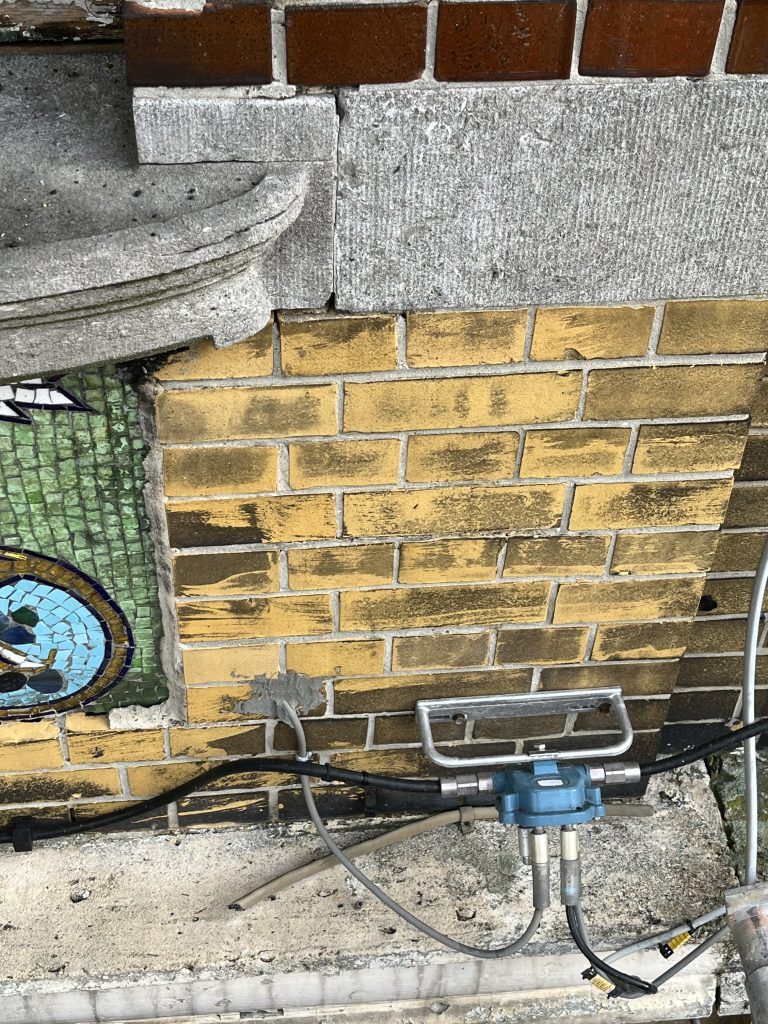
You can see the brush marks on the yellow bricks. This was my test section. I put some Alkaline based chemical cleaner on the dry bricks, and let it set for a copple of minutes, then i washed it off with high pressure and normal cold water.
Chemical cleaning — carefully
Chemical cleaning covers a wide range of products and approaches, and the variation between them is significant.
Acid-based cleaners are effective against mineral deposits, efflorescence, limescale, and certain types of metal staining. They work by dissolving the soiling through chemical reaction. The risk is that they will also dissolve the material beneath the soiling — limestone, lime render, and calcareous mortars are all vulnerable to acid attack. Acid should never be used on limestone, marble, or calcareous sandstone. On appropriate substrates — hard engineering brick, granite, certain hard sandstones — it can be effective when used correctly, applied at appropriate dilution and neutralised thoroughly after application.
Alkaline cleaners are effective against organic soiling, carbon deposits, and some biological growth. They are generally safer on calcareous materials than acids, but they too can cause damage if used at excessive concentration or left on the surface too long. Some alkaline products can cause long-term salt crystallisation problems if they are not thoroughly rinsed from the masonry.
Biological treatments — biocides and algaecides — address the organic growth that causes much of the soiling on historic buildings. Applied correctly, they kill the organism and allow its remains to be washed away. They are generally low-risk for the masonry itself, although some products can cause staining if not rinsed properly.
The general rule with chemical cleaning is: the weakest concentration that achieves the result is the right concentration. And always test first.
Dry ice blasting — no residue, no moisture
Dry ice blasting (droogijsstralen / CO2 stralen) is a cleaning method that deserves more attention in historic building restoration than it currently receives.
Pellets of frozen CO2 are propelled under pressure against the surface. On contact they sublimate — transitioning directly from solid to gas without passing through a liquid phase. The soiling is removed by thermal shock, mechanical impulse, and CO2 expansion beneath the soiling layer. Crucially, no residue is left behind.
For historic masonry: no water, no chemicals, no abrasive residue. The mechanical impulse is gentler than sandblasting. Particularly effective on organic soiling, soot, paint layers, and biological growth. Less effective on deeply ingrained mineral deposits.
Limitations: specialised equipment, trained operators required, higher cost per square metre than conventional methods. Most cost-effective on high-value decorative elements rather than large plain surfaces.
Abrasive cleaning — the most dangerous category
Abrasive cleaning methods remove soiling by mechanically abrading the surface. They are also the methods most likely to cause irreversible damage to historic masonry.
Sandblasting — propelling abrasive particles at the surface under pressure — is the most aggressive form of abrasive cleaning. On hard modern materials it can be appropriate. On historic masonry it should be avoided in almost all circumstances. Hard sandblasting removes not just the soiling but the surface of the stone or brick.

Hard sandblasting removes not just the soiling but the surface of the stone or brickbeneath it — the fired face of brick, the weathered skin of stone, the original texture that gives historic masonry its character. Once removed, this surface cannot be restored.
Soft washing with gentler abrasives — fine glass beads, crushed walnut shell, or similar materials at lower pressures — is less aggressive than conventional sandblasting but still carries significant risk on soft or friable historic materials. Soft stone — many limestones, soft sandstones, historic hand-pressed brick — can be eroded even by apparently gentle abrasive treatment. The risk is cumulative and not always immediately visible.
The conclusion is straightforward: abrasive cleaning methods should be the last resort on historic masonry, not the first choice. If they are used at all, they should be preceded by careful material assessment and tested in an inconspicuous location.
Laser cleaning — the precision option
Laser cleaning uses focused light energy to volatilise soiling from the surface without mechanical contact. It is highly precise — the operator can control the depth of treatment to fractions of a millimetre — and when used correctly it is one of the most material-friendly cleaning methods available.
Its limitations are cost and speed. Laser cleaning is significantly more expensive than other methods and is relatively slow, making it most appropriate for high-value decorative elements — carved stonework, inscriptions, fine architectural details — where precision matters more than speed.
For large plain surfaces, laser cleaning is rarely economical. For a significant carved detail where other methods would cause damage, it can be the only appropriate choice.
The sequence that makes sense
For most historic facade cleaning projects, the most effective approach combines methods rather than relying on a single one:
Start with the gentlest method that might achieve the result — low-pressure water, biological treatment for organic growth, steam for general soiling. Assess what remains. Apply targeted chemical treatment to specific staining types where water alone is insufficient. Reserve abrasive or more aggressive methods for specific areas where nothing else works, and only after material assessment confirms they are safe.
One practical point from experience: on facades with significant blue limestoneelements, address the limestone first — before any abrasive or chemical treatment that might affect adjacent materials. The dust from abrasive cleaning on adjacent brick can contaminate limestone surfaces in ways that are difficult to remove.
What the owner needs to understand
Facade cleaning is not a cosmetic operation. It is a maintenance intervention that affects the material condition of the building, and it should be approached with the same care as any other restoration work.
A cleaning that leaves the building looking good but has damaged the mortar joints, eroded the brick faces, or introduced moisture that will cause problems over the following winter has not been a success, whatever it looks like in the photographs.
Before commissioning cleaning work, ask the craftsperson what method they intend to use and why. Ask whether they have tested on the specific materials of your building. Ask what they will do if the first approach does not achieve the result.
The answers to those questions will tell you a great deal about the quality of the work that follows.
A question to the Guild
What is your default sequence for historic masonry cleaning — and has it changed over time as products and methods have developed?
Has anyone used laser cleaning on a domestic historic building project — and was the result worth the cost?
And on the question of combined approaches: what combinations have you found most effective for the specific soiling challenges of your region?
A clean facade is not necessarily a well-cleaned facade. The difference is in the method.
RestoreFacade Guild — for the craftspeople who know that how you clean matters as much as whether you clean.