A blog about gietijzer, catalogues, lost ornaments, and why a foundry in Belgium might be the most important restoration resource you’ve never heard of.
Let me start with a confession.
In the two blog posts this series dedicated to wrought iron — the preparation, the coatings, the colour — I never once clearly distinguished between wrought iron and cast iron. They are related materials, they often appear on the same building, and they are frequently confused — including, it must be said, by people who work with them. But they are fundamentally different in how they are made, how they behave, and how they should be restored.
This post sets that straight. And then it goes somewhere more interesting.
Wrought iron and cast iron — the difference that matters
Wrought iron (smeedijzer) is iron that has been worked — heated and hammered, shaped by the smith’s hand and tools while hot. It is fibrous, relatively flexible, and resistant to sudden fracture. A wrought iron bar can be bent without breaking. It can be welded to other wrought iron. It lends itself to the flowing, organic forms of Art Nouveau ironwork — the curves, the tendrils, the botanical details that a skilled blacksmith produces one heat at a time.
Cast iron (gietijzer) is iron that has been melted and poured into a mould. It is harder than wrought iron, more brittle, and incapable of being worked once cast. A cast iron element cannot be bent or shaped after leaving the mould — it is what it is. But it can be produced in complex shapes that would be extremely labour-intensive to forge by hand, and it can be reproduced in identical copies from the same mould as many times as required.
The practical implication for historic facades is straightforward. The decorative ironwork that was individually made — the balcony railings, the window grilles, the gate panels — is almost always wrought iron. The standardised, repeating elements — the bootscrapers, the decorative bolt covers, the column capitals, the ornamental brackets — are almost always cast iron.
The restoration approach is different for each. Wrought iron can be repaired by a blacksmith. Cast iron, when broken, cannot be welded in the conventional sense — the repair requires specialist casting or the sourcing of a replacement.
The catalogue tradition — ordering your facade by post
In the second half of the 19th century, industrial cast iron production reached a scale and a level of quality that made something previously unimaginable entirely routine: ordering architectural ornaments from a catalogue, like furniture from a shop.
The Corneau-Deville-Paillette foundry of Charleville in the French Ardennes published a catalogue in 1891 that illustrates this tradition perfectly. Among the domestic cast iron objects — stoves, pots, garden furniture — the catalogue includes architectural elements: lighting fixtures, grilles, balustrade components, decorative brackets, and the boot scrapers that appeared at the entrance of almost every quality house of the period.
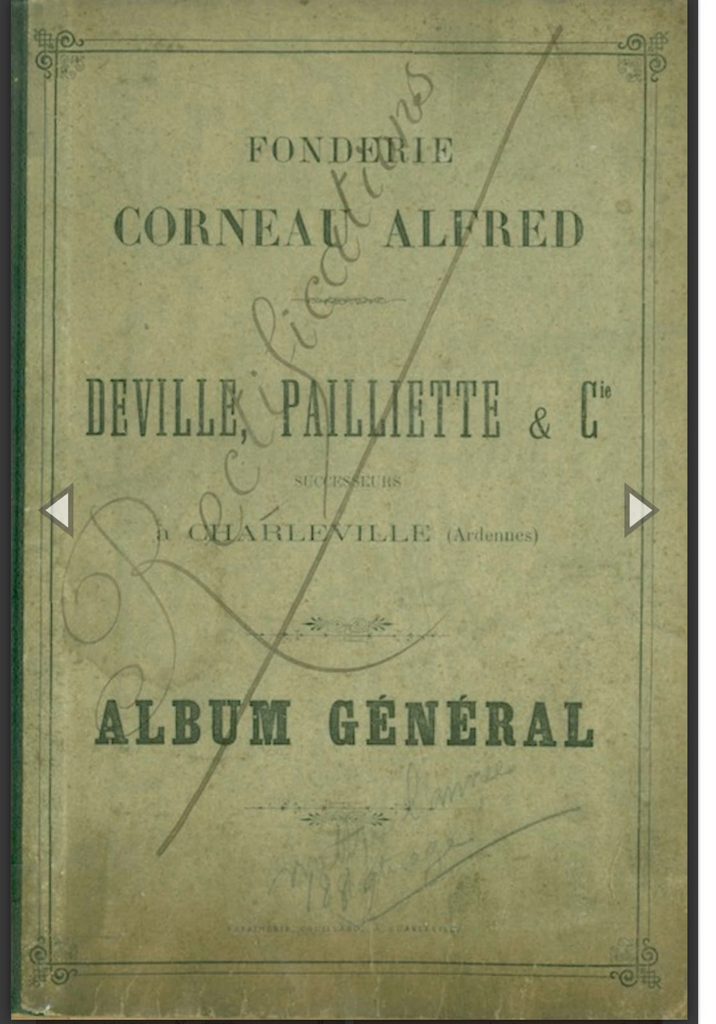
These catalogues were not documents of craftsmanship in the conventional sense. The craftsmanship — and it was considerable — lay in the design of the original pattern and the making of the first mould. Once that was done, reproduction was mechanical. A manufacturer in Charleville or St. Louis could supply identical boot scrapers to buildings across France or across Europe with no further skilled intervention required.
This is both the strength and the limitation of cast iron as a restoration material. The strength: if you can find the original mould, or make a new one from a surviving example, reproduction is straightforward and relatively economical at scale. The limitation: the original moulds are almost always lost, the manufacturers no longer exist, and the surviving examples are becoming rarer every year.
A boot scraper and a detective story
The connection between catalogue ironwork and the facade of Stenenbrug 99 in Antwerp is a story worth telling.
During the restoration work on that facade, i already saw the bootscraper was ,besides some spots of rust, in good condition— the kind of cast iron entry detail that appeared at the base of almost every quality townhouse of the Art Nouveau period. Cast into it was the name of its manufacturer. A small detail, easily overlooked.
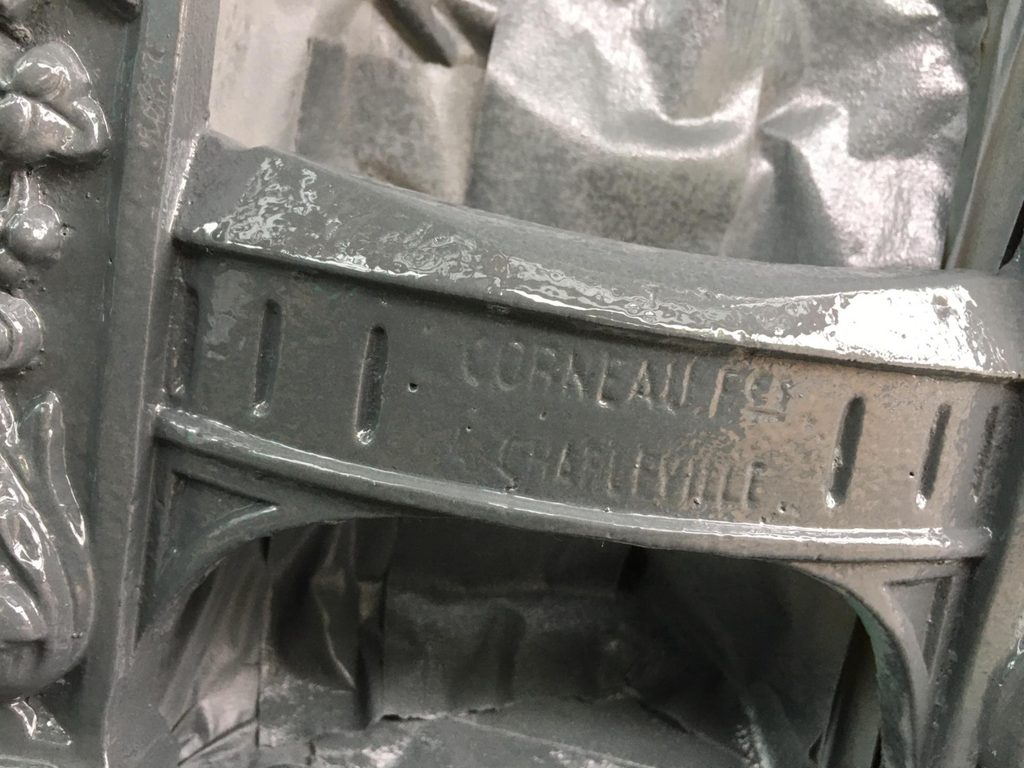
That name was searched. The search led to a foundry catalogue — the Corneau-DevillePaillette catalogue of 1891. And in that catalogue, the boot scraper was there. A standard item. Available to order under ‘Décrottoires n°4– Delivered by rail.
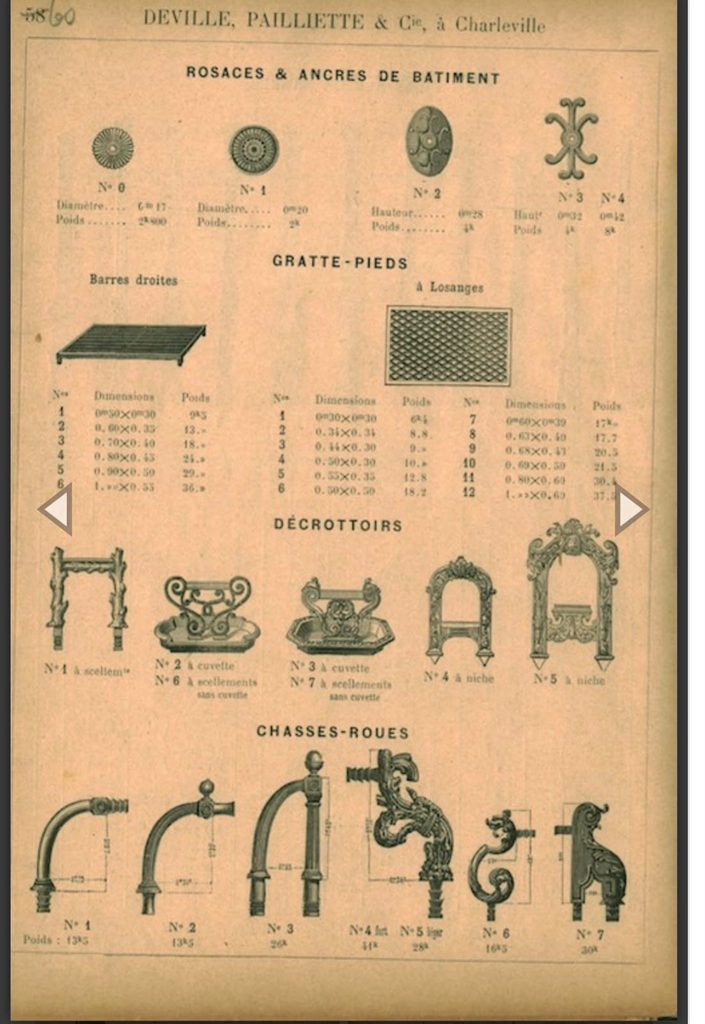
The building’s original owner had ordered a boot scraper from a French foundry catalogue, the same way a contemporary owner might order a door handle online. The object that seemed like a unique detail of a specific building was in fact a massproduced industrial product — one of hundreds, perhaps thousands, made from the same mould.
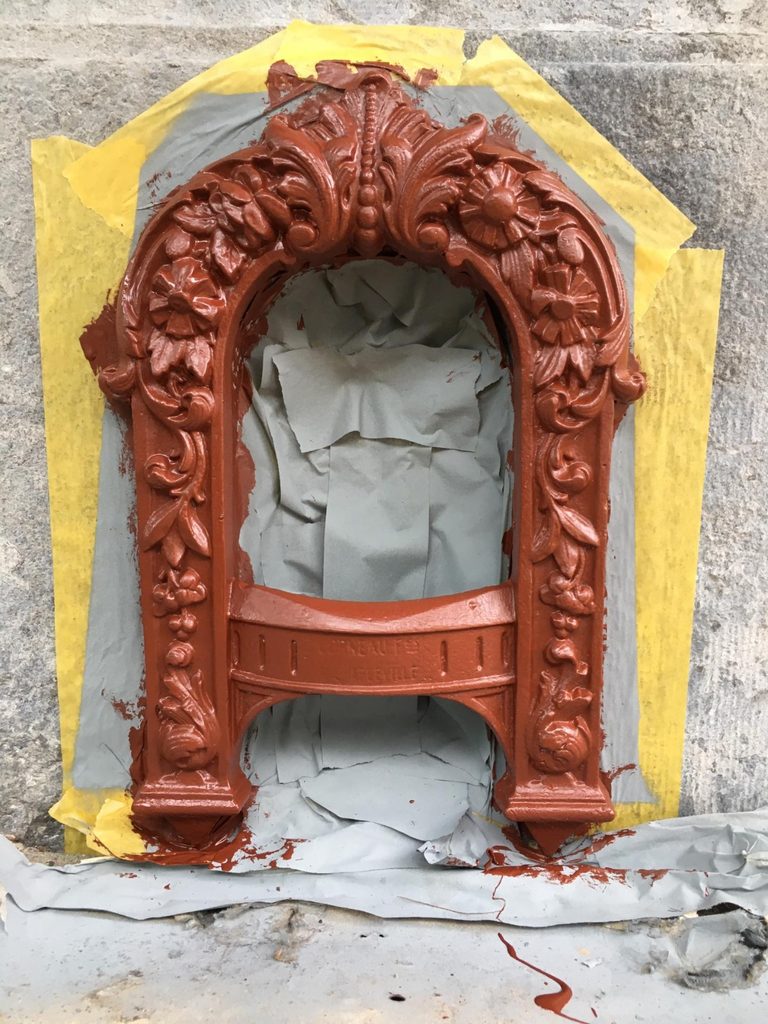
This discovery changed the way the restoration was approached. If the boot scraper was catalogue ironwork, what else might be? And if the moulds could be found, or new moulds made from surviving examples, what could be reproduced?
The poutrel flowers — a personal search
Inside the structure of the Stenenbrug 99 facade, the iron beams (poutrels) that carry the floor loads pass through the masonry at intervals. At each point where a bolt secures the structure, a decorative cast iron cover — a circular ornament, floral in design, what the French would call a “rosette poutrellen rosace cache-boulon, palmette, fleron or rosace pour fer à1”— was fitted over the bolt head.
These rondelles are extraordinarily fragile. Cast iron that thin, with that level of detail, does not survive rough handling or accidental impact. Over the years, many had been broken and discarded — lost when the building was indifferently maintained, or simply thrown away during previous repair work by people who did not understand what they were looking at.
Finding replacements became a small obsession.
My father had two. The neighbours of the Stenenbrug 99 owners had one. An antique dealer in Heist-op-den-Berg — the Medusa shop, now closed — had one or two more. Between these sources, enough were assembled to complete the restoration.
But the search made something clear: these objects are disappearing. They are fragile, they are small, they are not recognised for what they are by most people who encounter them during demolition or renovation. They end up in skips, or at the scrap merchant, or simply broken and discarded. Each one that goes is gone.
Gieterij De Reu — the answer that most people don’t know exists
While searching for replacement rondelles, a Belgian foundry came to attention that deserves to be far better known in the restoration community.
Gieterij De Reu ( www.gieterijdereu.be) is, in the simplest terms, a working foundry. A large melting furnace, fired at intervals. The capacity to cast iron in virtually any form, from any pattern or mould. And — crucially for restoration — the ability to make new moulds from original surviving examples.
The principle is straightforward. You bring a surviving original — a rondelle, a boot scraper, a balcony bracket, whatever cast iron element you need reproduced. The foundry makes a mould from it. That mould remains your property. And from that mould, you can order as many castings as you need — one, ten, a hundred — at a unit cost that decreases significantly with quantity.
This is not a theoretical possibility. It is a service that exists, in Belgium, and that is largely unknown to the people who most need it.
The implications for restoration work are significant. A broken cast iron element that appears irreplaceable — because no manufacturer still makes it, because no catalogue survives, because no other examples are known — may in fact be reproducible, provided a single intact original can be found. The search for that original becomes the restoration project, rather than the acceptance of permanent loss.
Whether to name a specific supplier in a restoration context is always a judgment call. The decision here is to name De Reu not as an endorsement but as information — the kind of information that the Guild exists to share, and that most people working on historic buildings in Belgium have never had.
There are almost certainly other foundries with similar capabilities in other European countries. The Guild would benefit from knowing about them.
a makers’s mark in cast iron
A maker’s Turn a cast-iron boot scraper over, or look closely at its side, and you will often find a name: Corneau Frs, Charleville. Founders signed their work. The mark was pressed into the sand mould, so it comes out in relief, and it tells you who made the piece and sometimes where.
The same habit ran through all of cast iron. This plate comes from my father’s collection: Babcock & Wilcox Ltd, London & Glasgow, dated 1932, with their “Steam Mark” in the centre. It is not a facade element. Most likely it was a maker’s plate from industrial boiler equipment. But look at the details: raised letters, a crisp border, a date cast straight into the metal. The technique is exactly the same as on a boot scraper or a rosette covering a bolt end on a steel I-beam.
It also shows what cast iron does when nobody looks after it: the paint flakes, rust blooms in the recesses, and the relief is the first place moisture settles. The same thing happens on a street-side facade.
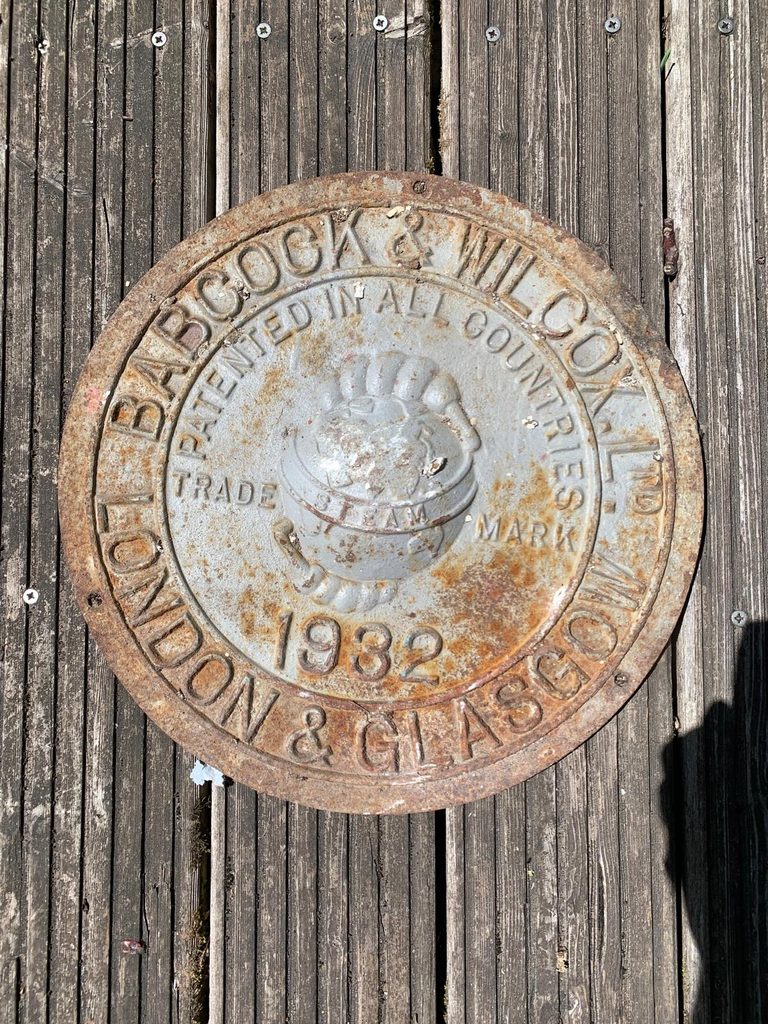
So next time you clean a cast-iron piece on a facade, check the edges and the back before you grind anything off. Is there a name, a number, a date?
What is the oldest maker’s mark you have found on a facade?
Cast iron in America — the catalogue facade
While in Europe cast iron appeared primarily as individual elements — balconies, railings, boot scrapers, decorative details — the United States took the material in a fundamentally different direction: the complete cast iron facade.
From the 1850s onward, American manufacturers developed systems of prefabricated cast iron panels that could be assembled to clad an entire building front. The Mesker Bros. Iron Works of St. Louis, Missouri — whose 1892 catalogue survives in the Internet Archive — offered complete facade systems: cornices, pilasters, window surrounds, decorative panels, and structural columns, all in cast iron, all designed to bebolted together on site.
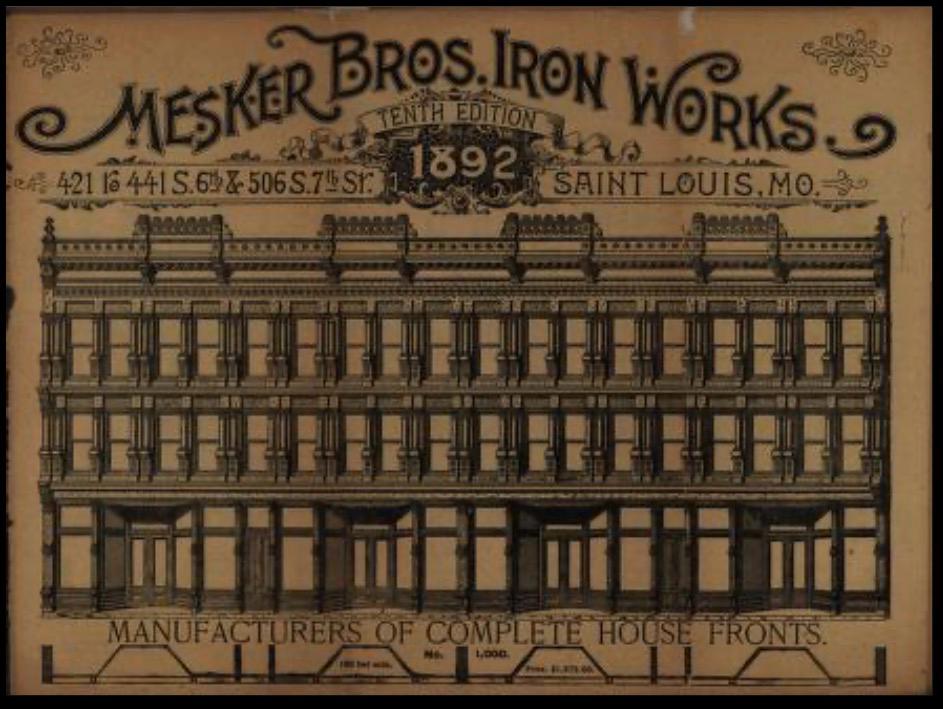
The surviving cast iron districts of New York’s SoHo neighbourhood and New Orleans’ French Quarter are the most visible legacy of this tradition. Their restoration presents exactly the challenges described above — original manufacturers gone, patterns lost, matching replacement elements requiring either salvaged originals or new castings.
The scale is different from European practice. The material and the restoration logic are the same.
Cast iron across the world — a colonial export
The cast iron facade tradition did not remain confined to Europe and America. Wherever British colonial and commercial influence reached in the 19th century, cast iron architectural elements followed — shipped from foundries in Glasgow, Birmingham, and Bristol to ports across the empire and beyond.
India — and Calcutta in particular — developed a distinctive cast iron building tradition under British influence. The elaborate cast iron verandas, balcony railings, and decorative columns that characterise the colonial architecture of the city were largely imported from British foundries, assembled on site, and adapted to the local climate. Many survive today in varying states of preservation.
Singapore and Hong Kong show the same pattern — the shophouse verandas and commercial building facades of both cities incorporated cast iron columns and decorative elements that arrived as catalogue items from British manufacturers.
Australia — particularly Melbourne and Sydney — developed what became known as the “lacework” tradition: elaborate cast iron veranda friezes, balcony railings, and decorative panels that became a defining characteristic of Victorian domestic architecture. The Australian lacework tradition is now recognised as a distinct regional development of the colonial cast iron vocabulary, and its restoration is an active field in Australian heritage conservation.
In all of these contexts, the restoration challenges are the same: original manufacturers gone, patterns lost, matching replacement castings requiring either salvaged originals or new mould-making from surviving examples.
The foundry solution described above — bringing a surviving original to a working foundry, having a mould made, and owning that mould for future reproduction — applies as much in Melbourne or Calcutta as it does in Antwerp.
What is still out there
Cast iron architectural elements from the late 19th and early 20th century still appear — on buildings that have not yet been restored, in antique markets, at architectural salvage dealers, occasionally at scrap merchants who do not know what they have.
The zinc-framed dormer window surrounds that appeared on the better houses of the Art Nouveau period. The decorative rondelles from poutrel fixings. Boot scrapers. Balcony brackets. Column capitals.
These objects are not infinitely replaceable. Each one that reaches the scrap merchant is gone. Each one that survives intact is potentially the pattern from which a new mould can be made — and from which dozens of replacements can be cast for buildings that have lost their originals.
If you encounter cast iron architectural elements — on a building you are working on, at a salvage dealer, at an antique market — look carefully before dismissing them. What looks like scrap may be the last surviving example of something that appeared on dozens of buildings in your city.
A question to the Guild
Has anyone worked with a foundry to reproduce cast iron architectural elements from historic buildings? What was the process, and what were the results?
And does anyone know of foundries in other European countries — France, the Netherlands, Germany, the UK — with similar capabilities to Gieterij De Reu? Building a European map of foundries capable of casting from historic patterns would be genuinely useful knowledge for the restoration community.
The mould, once made, is yours. The knowledge of where to make it should beeveryone’s.
RestoreFacade Guild — for the craftspeople who know that what looks like scrap sometimes isn’t.