Part 5 of 5: The Ceramic, Glass and Mosaic Series
The previous four posts in this series have covered the history of ceramic on facades, the specifics of glazed brick, the challenges of mosaic panels, and the use of decorative glass as an architectural surface material. This final post addresses the practical question that all of that history leads to: when something is damaged or lost, what do you actually do about it?
The answer is different for each material. What follows is a practical guide — not exhaustive, but grounded — for each of the four material types covered in this series.
Before anything else — diagnose before you intervene
This principle has appeared in several posts in this series, and it appears again here because it is the most violated principle in the restoration of ceramic, glass and mosaic on historic facades.
The temptation, when faced with a damaged panel, a missing tessera, or a cracked glazed brick, is to act immediately. To replace. To repair. To make it look right again.
The problem is that the wrong intervention — applied without understanding why the damage occurred — will fail in the same way as whatever it replaced. A mosaic panel that has delaminated from its backing because of moisture movement from the wall behind it will delaminate again if the moisture source is not addressed. A glazed brick that has failed because of incompatible cement pointing will be joined by its neighbours if the pointing is not corrected at the same time.
Diagnosis before intervention. Every time.
Ceramic tiles — the most common and most mishandled
Ceramic tiles on historic facades — whether the azulejos of Portugal, the faience panels of Art Nouveau Belgium, or the plain glazed tiles that appear as decorative accents on countless late 19th century buildings — are among the most frequently damaged and most frequently misrestored elements in the entire field.
Assessment first. Tap each tile with a knuckle. A solid sound indicates good adhesion to the substrate. A hollow sound — and in a damaged facade there will be many — indicates that the tile has lost contact with the mortar bed behind it. A hollowed tile is not necessarily about to fall, but it is no longer performing its protective function and is vulnerable to frost damage and further detachment. Map the hollow areas systematically before deciding on an approach.
Why tiles fail. Ceramic tiles on facades fail for several reasons, and identifying the correct cause determines the correct response. Moisture penetrating behind the tile through failed pointing or cracked grout joints causes the mortar bed to soften and lose adhesion. Frost damage — water freezing in the pores of the mortar bed and expanding — physically breaks the bond between tile and substrate. Incompatible mortar used in previous repairs — cement, typically — creates differential movement that the original adhesion system cannot accommodate. And sometimes the original installation was simply poor, and the tiles have been waiting decades for the opportunity to fall.
Matching replacement tiles. This is the central challenge of historic tile restoration, and it deserves honest acknowledgement: a perfect match is rarely achievable. Historic tiles were produced by manufacturers who no longer exist, in colours and glazes that have not been reproduced. The colour of a ceramic glaze changes with firing temperature, clay body composition, and the specific oxide concentrations used — variables that are not documented for most historic tile production. The goal is the closest achievable match, assessed under multiple lighting conditions and compared against both the original tiles and the weathered appearance they have developed over decades.
Specialist suppliers — particularly in Belgium, the Netherlands, Portugal, and Spain — stock ranges of reproduction tiles that can provide acceptable matches for common historic types. For unusual or highly specific tiles, custom production is possible but expensive and subject to minimum order quantities that make small repairs uneconomical.
The substrate question. Before any tile is replaced, the substrate it will be fixed to must be assessed. A tile fixed to a damaged, damp, or structurally unstable substrate will fail again regardless of how well the tile itself is selected and fixed. Address the substrate first — repair or replace damaged render, address moisture sources, allow the wall to dry — before any new tile is installed.
Adhesive compatibility. Historic tiles were fixed with lime-based mortars.Replacement tiles fixed with modern cement-based adhesives or synthetic tile adhesives introduce materials with very different stiffness and thermal expansion characteristics from the surrounding historic fabric. Over time, this incompatibility causes stress at the boundaries between old and new, leading to failure of the repair and sometimes damage to surviving original tiles adjacent to it. Lime-based adhesives, or specialist restoration adhesives formulated to be compatible with historic substrates, are almost always the correct choice.
Never grout with cement. The pointing between historic ceramic tiles should be limebased — soft, breathable, and sacrificial. Cement grout in the joints of a historic tile facade is harder than the tile body in many cases, traps moisture, and introduces sulphates that accelerate deterioration. It also looks wrong.
Glazed brick — what works and what doesn’t
Assessment first. Tap the glazed surface with a knuckle or a small hammer. A solidsound indicates good adhesion. A hollow sound indicates that the glaze has separated from the clay body, or that the brick itself has separated from the mortar bed. Map the hollow areas before deciding what to do.
Causes of failure. Glazed brick fails for several reasons: frost damage to the brick body behind the glaze; salt crystallisation pushing the glaze from inside; incompatible mortar in the joints creating differential movement; or simply age and thermal cycling over many decades. Each cause has a different response.
Matching replacement brick. This is the central challenge of glazed brick restoration, and it must be acknowledged honestly: perfect matching is usually not achievable. Historic glazed brick was produced in small batches by manufacturers who no longer exist. The colour, texture, and reflective character of the original glaze cannot be precisely replicated. The goal is the closest achievable match — which requires sourcing from specialist suppliers, comparing samples under multiple lighting conditions, and accepting that some visible difference between old and new is preferable to the alternative of leaving damaged brick in place.
Repointing around glazed brick. The mortar at the joints of a glazed brick facade must be softer than the brick — the standard rule for all historic masonry — but it must also be compatible with the impermeable glazed face. Lime mortar is almost always the correct choice. Cement in the joints of a glazed brick facade is particularly damaging because the cement is harder than the historic brick body and introduces sulphates that accelerate deterioration.
Never paint over glazed brick. If the glaze is damaged or discoloured, paint is not the solution. It traps moisture, fails quickly, and leaves the surface in worse condition than before.
Mosaic — stabilise, source, reconstruct
Stabilisation of loose tesserae. Before any reconstruction, loose tesserae must be stabilised. Small areas of detachment can be re-bedded with a compatible lime-based adhesive injected carefully behind the tessera. Larger areas of delamination may require the removal and re-laying of entire sections. The adhesive must be compatible with both the tessera material — glass, ceramic, or stone — and the mortar bed beneath it.
Addressing the moisture source. Mosaic panels that have failed due to moisture movement from the wall behind will fail again unless the moisture is addressed. This may mean improving drainage around the building, addressing failed pointing or render on the wall surface, or improving the waterproofing of the facade above the panel. The panel cannot be properly restored until the wall it sits in is stable.
Sourcing replacement tesserae. For glass mosaic, specialist suppliers in Italy — particularly in Venice and the Friuli region — continue to produce smalti and Venetian glass tesserae in a wide range of colours. Matching historic colours requires samples and comparison, and the match will never be perfect because historic glass weathers and changes colour over decades in ways that new glass has not yet done. For ceramic tesserae, specialist tile manufacturers can produce custom colours, but the lead time and minimum order quantities can make small repairs uneconomic.
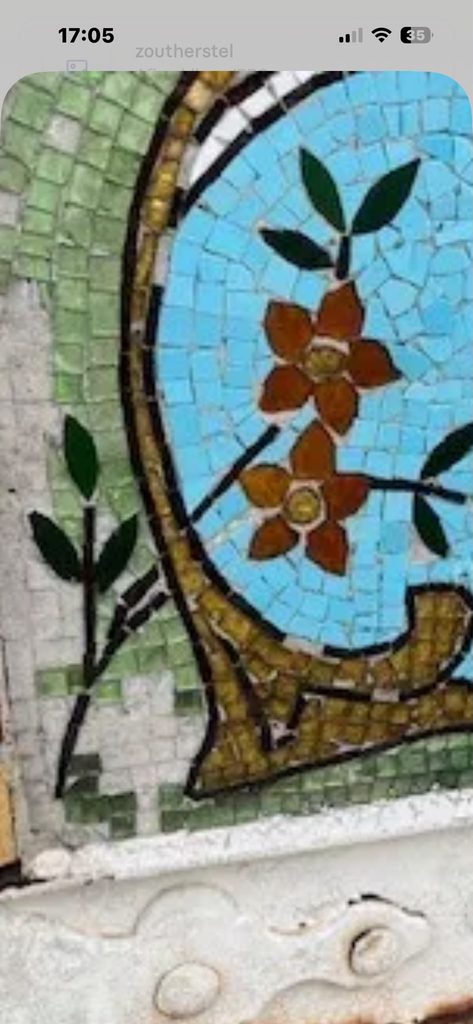
In this panel, the green glass tesserae have come loose far more often than the enamel pieces right next to them, even though both sit in the same mortar bed. My guess is it comes down to adhesion: glass has a smoother backside than the typically rougher, more porous enamel tesserae, giving the mortar less to grip onto. Thermal expansion may play a role too, if the glass warms differently than opaque enamel does in direct sun
Has anyone else noticed this pattern, glass versus enamel, on their own mosaic work?
Reconstruction of lost areas. Where significant areas of mosaic have been lost, reconstruction requires reference material. Photographs, surviving fragments, comparable panels on the same building or by the same designer — all of these are more valuable than any amount of speculation. Where no reference exists, the honest approach is to document what remains, stabilise it, and accept the loss rather than invent a reconstruction.
Prefabricated panels. For mosaic panels that were originally set into prepared recesses in the facade, the recess itself must be assessed before any new panel is installed. Is the recess geometry correct? Is the substrate sound? Is there evidence of moisture movement from the wall behind? The answers to these questions determine whether a new panel can be installed directly or whether preparatory work is needed first.
Decorative glass — putty, lead, and the painted surface
Linseed oil putty renewal. This is the most common and most overlooked maintenance task for decorative glass in timber frames. Putty that has dried, cracked, and begun to detach should be renewed before water reaches the timber behind it. The old putty is removed carefully — a sharp chisel and patience, not a heat gun that risks cracking the glass. The rebate is primed with linseed oil or a compatible primer. Fresh linseed oil putty is pressed in and finished with a chamfered face. The putty is then primed and painted when it has skinned sufficiently — typically after two to four weeks.
Releading lead-camed panels. A panel with badly oxidised or fatigued lead came needs to be disassembled and releaded. The glass is removed carefully, cleaned, and assessed — cracked or broken pieces are replaced with matching glass where available. New lead came of the appropriate profile is cut and assembled around the original glass. The panel is then re-installed in its original position with appropriate waterproofing at the perimeter.
Painted glass under later coatings. Where original painted decoration has been covered by later paint layers, specialist assessment is essential before any attempt at removal. The solvent or mechanical approach that removes the later paint may also damage the original painting beneath it — or may find that the original painting has already been lost, with nothing recoverable beneath the later coat. A small test area in an inconspicuous location, assessed by a specialist in painted glass conservation, is the only responsible first step.
Matching replacement glass. For decorative glass panels where sections must be replaced, matching the original glass — its colour, its texture, its degree of transparency — is as challenging as matching historic glazed brick or mosaic tesserae. Antique glass, salvaged from other demolished buildings, is sometimes the best source of a convincing match. Specialist glass manufacturers can produce custom colours and textures, but the cost is significant and the results are variable.
The question of what is lost and what can be saved
In every ceramic, glass and mosaic restoration project, there comes a point where this question must be answered honestly.
Some damage is irreversible. Glazed brick that has been destroyed by frost or salt crystallisation cannot be restored — it can only be replaced. Mosaic tesserae that have been lost are gone — they can be replaced with new material, but the original is not recoverable. Painted glass decoration that has been dissolved by an incompatible solvent is gone permanently.
Acknowledging what has been lost is not defeatist. It is the precondition for making good decisions about what remains. The material that has survived a century or more is the material worth protecting. The energy and resources of a restoration project are best directed at saving what is there, not reconstructing what is not.
The Guild’s expertise
The members of the RestoreFacade Guild bring collective expertise across all of the material types covered in this series. Melissa works with glazed tiles and glazed brick on historic facades. Hélène, Pierre, Jonathan, Paulo José, Emmanuelle, Jean, Ellen, Adélie and Gregory bring expertise in painted glass, stained glass, and architectural glazing. Between them, and alongside the craftspeople working in stone, lime, and ironwork covered elsewhere in the Guild, the knowledge needed to approachthese materials correctly exists within the community.
The purpose of the Guild is to make that knowledge findable — by the property owners who need it, by the craftspeople who want to learn from colleagues, and by the heritage professionals who need to know who can actually do this work.
A final question to close the series
Looking back across the five posts: which of these four materials — glazed brick, mosaic, decorative glass, or historic ceramic tile — do you think is the most at risk in the European buildings you work on or care about?
And which restoration challenge do you find least well documented — where the available guidance is thinnest and the practitioner knowledge most needed?
The Guild is here to fill those gaps. One conversation at a time.
RestoreFacade Guild — for the craftspeople who understand that what is fired, glazed, and set into a historic facade deserves more than a general contractor with a caulking gun.
This completes the five-part Ceramic, Glass and Mosaic series. The series covered: the history of ceramic in architecture; glazed brick; mosaic panels in facades; decorative glass as a facade material; and the restoration approach for all four.