Part 3 of 5: The Ceramic, Glass and Mosaic Series
There is something paradoxical about mosaic on a historic facade.
It is, in principle, one of the most durable decorative finishes available. The tesserae — those small units of stone, glass, or ceramic that make up the mosaic surface — are individually among the hardest and most resistant materials used in historic buildings. Glass mosaic tesserae can survive for centuries in conditions that would destroy paint, render, or timber in decades. The mosaic tradition has produced works that have lasted two thousand years.
And yet, on building facades, mosaic fails. Panels fall. Tesserae detach. Sections are lost, sometimes entirely, sometimes leaving only the ghost of an image in the mortar bed that once held it. The paradox of an extremely durable material in a fragile installation is the central challenge of mosaic restoration.
Understanding why it fails is the beginning of understanding how to save it.
What facade mosaic actually is
The term mosaic covers a range of different constructions, and the distinctions matter for restoration.
Direct mosaic is the oldest method: tesserae set individually, face up, directly into a fresh mortar bed. The craftsperson places each piece by hand, reading the composition from the front as it develops. The result has a characteristic surface variation — slight irregularities in the plane of the tesserae, differences in the angle at which individual pieces catch the light — that gives direct mosaic its distinctive visual quality.
Indirect mosaic was developed to allow workshop production of panels that could be installed on site. Tesserae are set face down onto a paper or fabric backing, creating a panel that can be transported and installed as a unit. On site, the panel is pressed into a fresh mortar bed, the backing is dampened and removed, and the mosaic surface isrevealed. Indirect mosaic allows for more controlled composition and faster installation than direct work, but the surface is typically flatter and more uniform.
Prefabricated mosaic panels — manufactured in a workshop and supplied ready to install — became increasingly common in the late 19th and early 20th century as industrial production methods were applied to mosaic manufacture. Many of the mosaic panels on Art Nouveau facades were supplied as prefabricated units, set into prepared recesses in the facade rather than applied to a flat wall surface. This is important for restoration: a panel that was always a discrete unit, set into a recess, has different structural behaviour and different failure modes from mosaic applied continuously across a wall surface.
The tesserae themselves
The materials used for mosaic tesserae in historic facades vary considerably, and the variation affects both the visual character of the mosaic and its restoration requirements.
Smalti — glass tesserae produced by a specific Italian technique involving the fusion of glass with metal oxides to produce intense, opaque colours — are among the most beautiful and most durable mosaic materials. The gold and silver smalti characteristic of Byzantine mosaics are made by sandwiching metal leaf between two layers of glass. Smalti tesserae have a slightly irregular, handmade character that gives them their particular visual quality under raking light.
Venetian glass tesserae — produced industrially from the 19th century onward — are more uniform in size and colour than smalti, and were widely used in the commercial mosaic production that supplied Art Nouveau and later buildings across Europe.
Ceramic tesserae — cut from fired ceramic tile rather than glass — appear in many historic facade mosaics, often combined with glass tesserae in the same panel. They are generally more opaque than glass and have a different surface character.
Natural stone tesserae — marble, limestone, and other stones cut into small units — are more commonly found in floor mosaics than in facade applications, but they appear in some exterior contexts, particularly in warmer climates where the freeze-thaw cycle is less of a concern.
How panels were fixed — and why this matters
The method by which a mosaic panel was originally fixed to the facade determines, in large part, how it fails and what can be done to save it.
Historic mosaic installation used mortar-based adhesion systems — lime mortars, sometimes with additives to improve adhesion and flexibility. These mortars were compatible with the historic substrate, breathable, and capable of accommodating the differential thermal movement between the mosaic and the wall behind it.
The failure mode of lime-bedded mosaic is typically gradual. As the mortar ages and loses strength, the bond between the tessera and the mortar bed weakens. This process accelerates where moisture is present — either from the wall behind or from water penetration through joints in the mosaic surface — because wet lime mortar has significantly lower strength than dry. The failure is usually visible: tesserae begin to sound hollow when tapped, a reliable indication that the bond has failed even where the tessera has not yet detached.
Later repairs — carried out with cement-based adhesives or modern synthetic adhesives — have introduced new failure modes. Cement adhesives are harder and less flexible than the original lime mortars, and they do not accommodate differential movement in the same way. They can also be aggressive to historic tesserae — particularly glass — through chemical reaction over time. And they are much harder to remove cleanly when the repair itself eventually fails.
The specific challenge of prefabricated panels
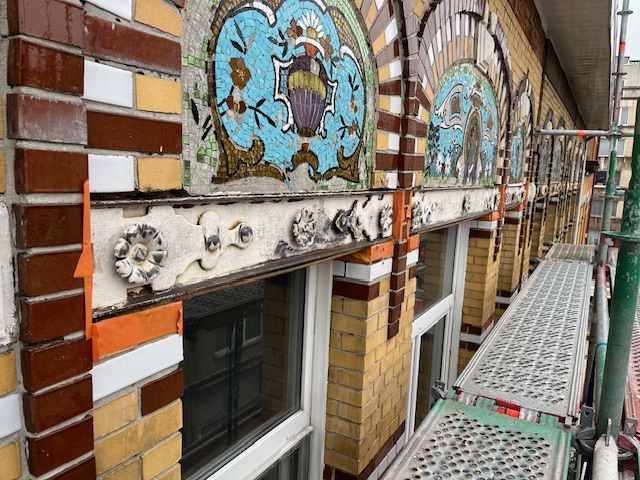
The mosaic panels that appear in the uitsparingen — the prepared recesses — of Art Nouveau facades represent a specific and interesting restoration challenge.
These panels were typically manufactured as discrete units, set into recesses that were designed to receive them. The panel and the recess are related — the panel dimensions were calculated for the specific opening, and the fixing was designed for the specific panel weight and substrate condition.
When such a panel fails — when sections detach, or the panel begins to separate from the wall — the restoration must address both the panel itself and the recess it sits in. Is the substrate sound? Is there moisture movement from the wall behind the panel that has attacked the bedding mortar? Is the recess geometry still correct, or has movement in the wall fabric changed the dimensions?
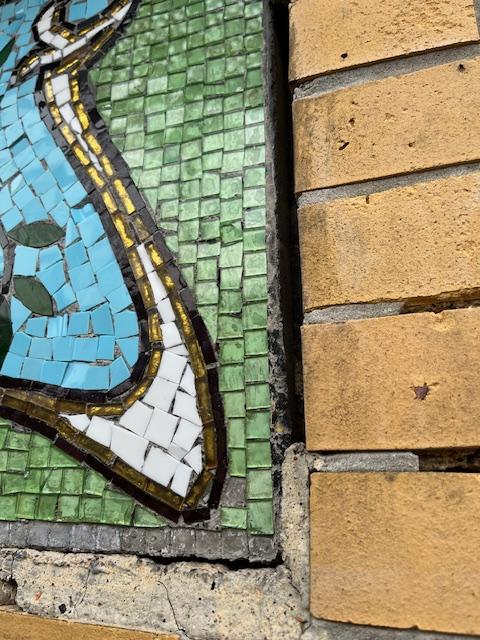
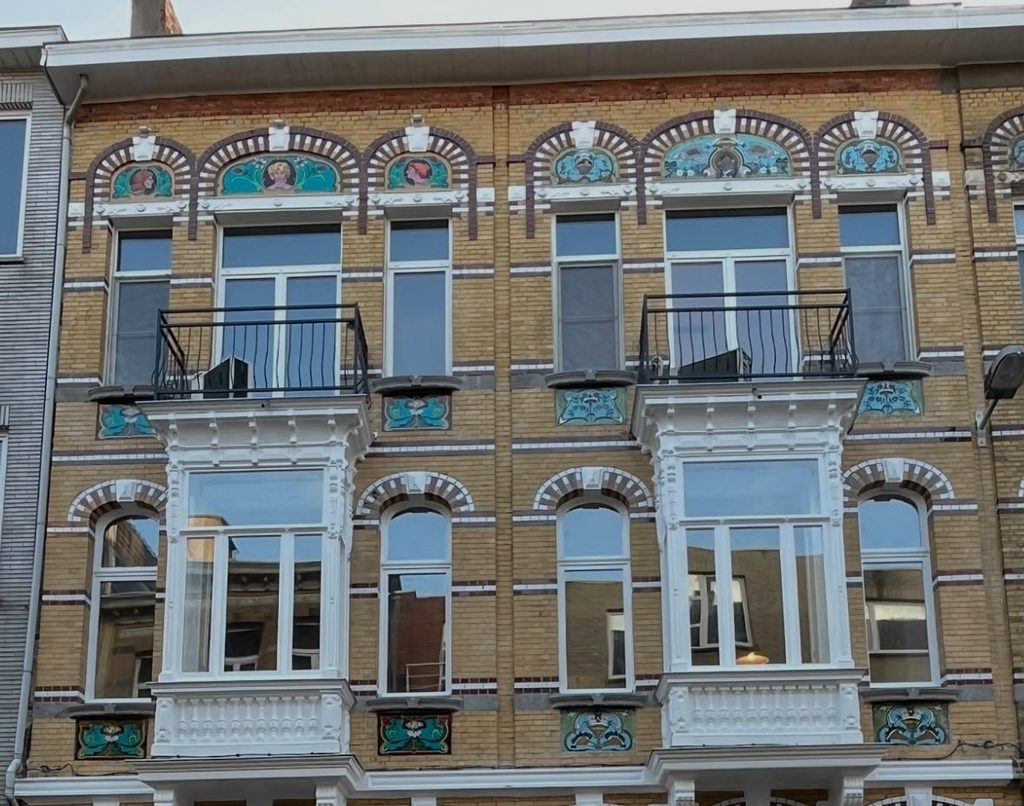
I, myself has seen examples of these prefabricated mosaic panels on the Jaak de Braeckeleerstaat 8/10 facade in Antwerp — panels set into purpose-made recesses alongside decorative glass panels on the adjacent half of the building. I put the pictures here. The question of how thosepanels were originally fixed, and what holds them now, is one that has not yet been fully answered for that specific building — a reminder that the documentation of original fixing methods is itself valuable knowledge that the Guild should be gathering.
What can be saved — and what cannot
When a historic mosaic panel has suffered significant loss, the options for restoration fall into a spectrum.
Conservation in place — stabilising the existing material without major intervention — is always preferable where it is achievable. Re-bedding loose tesserae with appropriate lime-based adhesive, injecting weakened areas of the mortar bed with a compatible consolidant, addressing the causes of moisture ingress — these measures can significantly extend the life of a damaged panel without requiring reconstruction.
Partial reconstruction — replacing lost tesserae with matching materials while retaining all surviving original material — is appropriate where areas of loss are limited and matching tesserae are available. The challenge is sourcing: historic tesserae colours may not be available in current production, and even where nominally similar tesserae can be found, the exact colour, texture, and reflective character of the originals is rarely perfectly matched.
Full reconstruction — where the panel has been so extensively lost that it no longer reads as coherent — is the most difficult decision. A full reconstruction requires reference material: photographs, drawings, or surviving fragments that establish what the original looked like. Without reference, reconstruction becomes invention, which is a different thing entirely.
Documentation and acceptance of loss — recording what remains before it deteriorates further, and accepting that some losses are irreversible — is sometimes the honest conclusion. Not every damaged mosaic panel can or should be reconstructed. The integrity of what remains is more valuable than a speculative reconstruction of what has been lost.
A question to the Guild
Has anyone worked on the restoration of mosaic panels in a facade context — either direct mosaic or prefabricated panels? The specific questions of adhesive compatibility, tessera sourcing, and the assessment of mortar bed condition all seem like areas where practitioner experience would be valuable.
And has anyone encountered the combination of mosaic and decorative glass panels on the same facade — the situation described above at the Jaak de Braeckeleerstraat 8/10, in Antwerp? The question of how these two very different materials were integrated in the original design and installation is one the Guild might be well placed to answer.
RestoreFacade Guild — for the craftspeople who understand that small pieces, properly placed, can outlast almost everything else.
Next in the series: Decorative Glass in Facades — not windows, but glass as an architectural surface material.