Part 1 of 5: The Ceramic, Glass and Mosaic Series
Before paint. Before render. Before almost any of the surface treatments we associate with historic facades today, there was fired clay.
Ceramic — in its broadest sense, any material shaped from clay and hardened by heat — is one of the oldest building materials in human history. It appeared on facades thousands of years before the 19th century townhouses that most of RestoreFacade’s work concerns. Understanding that history is not merely interesting. It explains why ceramic belongs on historic buildings, what it is doing there, and why its restoration demands a level of care and knowledge that most general contractors are not equipped to provide.
The beginning — fired brick and tile in antiquity
The earliest use of fired ceramic in architecture was not decorative but structural. Fired brick — clay shaped into units and hardened in a kiln — appeared in Mesopotamia around 3000 BCE, initially for use in foundations and areas exposed to moisture where sun-dried mud brick would fail.
Glazed brick followed. The Ishtar Gate of Babylon, built around 575 BCE, is perhaps the most famous early example of glazed ceramic used as a facade element — its deep blue and turquoise glazed bricks, decorated with figures of animals in relief, demonstrate a level of technical sophistication that remained unsurpassed in the ancient world.
The glaze served a dual purpose. It protected the ceramic body beneath from water penetration — glazed brick is far more durable than unglazed in wet conditions — and it provided a surface of extraordinary visual richness. The colour, achieved through metal oxide pigments fused into the clay surface during firing, was permanent and resistant to weathering in ways that any paint-based alternative could never match.
The Romans carried ceramic technology across their empire. Roman tile manufacture — standardised, large-scale, and of consistent quality — covered the roofs and floors ofbuildings from Scotland to Syria. Terracotta architectural elements — cornices, antefixes, decorative panels — appeared on public and private buildings throughout the Roman world. And in the eastern Mediterranean, the mosaic tradition that would define Byzantine architecture for centuries was already developing.
Byzantium and the mosaic tradition
The connection between ceramic and mosaic requires a brief clarification. Mosaic, strictly speaking, uses tesserae — small units of stone, glass, or ceramic — set into a mortar or adhesive bed to create images and patterns. The individual tesserae are not themselves glazed ceramic, but the tradition of mosaic decoration is intimately connected with the ceramic arts, and in many historic facades the two appear together.
Byzantine architecture elevated mosaic to an art form of extraordinary refinement. The gold and coloured glass tesserae of the great Byzantine churches — Hagia Sophia in Constantinople, San Vitale in Ravenna, the mosaics of Palermo — create effects that no painted surface can reproduce: the play of light on uneven gold surfaces, the depth of colour in hand-cut glass, the ability to read complex figurative compositions from great distances.
What is less often recognised is that the Byzantine mosaic tradition did not remain confined to religious architecture. As it spread through medieval Europe, adapted by local craftspeople with local materials and local conventions, it found its way onto domestic and civic facades — particularly in regions where the Byzantine influence was strongest, and where the climate made durable, washable surfaces practically desirable.
Islamic tile and the spread of glazed ceramic
Parallel to the Byzantine tradition, and eventually intersecting with it, the Islamic world developed its own ceramic traditions that would have profound consequences for European facade decoration.
The characteristic tilework of the Islamic world — geometric patterns in blue, white, turquoise, and other colours, covering entire wall surfaces — developed across Persia, Anatolia, and the Maghreb from the early medieval period onward. The techniques involved — tin-glazed earthenware, underglaze painting, cuerda seca and cuenca methods of keeping colours separate during firing — were sophisticated, labourintensive, and capable of producing effects of great beauty and durability.
When Islamic ceramic traditions met European ones — in Spain and Portugal above all, but also through trade and cultural exchange across the Mediterranean — the result was the emergence of new hybrid ceramic traditions that would eventually produce the azulejo of the Iberian peninsula and the maiolica of Italy.
The azulejo — discussed in the first post of the Heritage across Europe series — is the most consequential of these hybrid traditions for the history of facade ceramic. Its development from a simple geometric floor tile to the elaborate pictorial facade panels of 17th and 18th century Portugal represents one of the most complete integrations of ceramic and architecture in European history.
Renaissance Italy and the terracotta revival
In parallel with the development of Islamic-influenced ceramic in Iberia, Renaissance Italy rediscovered the ceramic traditions of antiquity and applied them to new architectural programmes.
Terracotta — fired but unglazed clay — was used extensively in northern Italian Renaissance architecture for decorative elements that would have been carved in stone in other traditions: pilasters, capitals, friezes, medallions, window surrounds. The Certosa di Pavia, begun in 1396, is perhaps the most spectacular example — its facade covered in elaborate terracotta decoration of extraordinary refinement.
Glazed terracotta — most famously in the work of the della Robbia family in Florence — brought colour into the equation. The characteristic blue and white glazed reliefs of Luca and Andrea della Robbia, set into architectural contexts throughout Tuscany and beyond, demonstrated that glazed ceramic could serve not just as surface decoration but as integrated architectural ornament.
The 19th century — industrial production and the return of ceramic to facades
The industrial revolution transformed ceramic production as it transformed everything else. Machine-made brick, tile, and terracotta became available in quantities and at prices that made them accessible for domestic architecture in ways that had never previously been possible.
This democratisation of ceramic had profound consequences for the historic buildings that RestoreFacade concerns itself with most directly.
The Victorian Gothic Revival in Britain used terracotta extensively — both as a structural material and as decorative cladding on a scale that had not been seen since the Renaissance. The red and buff terracotta facades of Victorian civic buildings, department stores, and housing are a characteristic feature of British cities from the 1860s onward.
In Belgium, the Netherlands, and France, encaustic tile — patterned floor tile made by pressing different coloured clays into a mould — appeared in churches, public buildings, and quality domestic architecture throughout the later 19th century. Simultaneously, faience — tin-glazed earthenware produced in a range of colours — was being used for decorative panels, shop fronts, and architectural details.
And then came Art Nouveau.
Art Nouveau and the ceramic facade
The integration of ceramic into the Art Nouveau facade is one of the defining characteristics of the movement — and one of the most demanding aspects of its restoration.
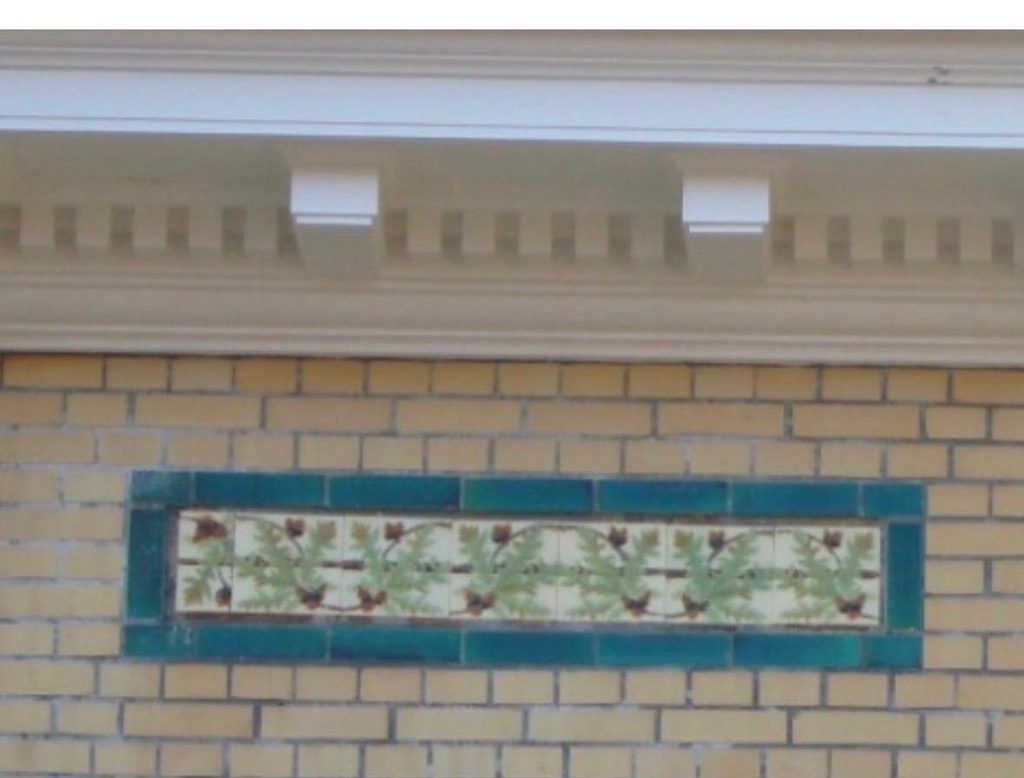
Art Nouveau architects and designers saw ceramic not as a surface applied to a building but as an integral part of its architectural language. Glazed brick in multiple colours, ceramic tile panels, faience reliefs, mosaic accents — all of these appeared together on the most ambitious Art Nouveau facades, coordinated as part of a designed totality.
In Belgium particularly — where Art Nouveau found its most concentrated domestic expression — the use of ceramic on residential facades was remarkably inventive. Glazed brick in cream, green, and gold tones. Ceramic tile panels set into render. Faience decorations around window openings. Mosaic panels at key compositional moments.
And it is here that the work of the Guild begins.
Melissa, one of RestoreFacade’s founding members in Belgium, specialises in exactly this territory — the restoration of glazed tiles and glazed brick on historic facades. Her work addresses the specific challenges that this material presents: sourcing replacements that match the originals in colour, glaze, and dimension; understanding the adhesion systems used in original installation; assessing and addressing the structural causes of tile failure that, if not resolved, will cause any new installation to fail in its turn.
Her presence in the Guild is a reminder that this knowledge exists, that it is practised,and that it needs to be connected with the buildings and owners that need it.
What the series covers
This is the first of five posts in the Ceramic, Glass and Mosaic series. The posts that follow will look at:
- Glazed brick — its specific properties, its use in Art Nouveau and later facades, and its restoration challenges
- Mosaic panels in facades — how they were made, how they were fixed, and what happens when they fail
- Decorative glass in facades — not windows, but the use of glass as an architectural surface material
- Restoration today — sourcing, matching, adhesion, and the question of what to do when the original material is no longer available
A question to the Guild to open the series:
When did you first encounter historic ceramic — glazed brick, tile, or mosaic — on a facade project? Was it something you had been trained to work with, or did you have to learn as you went?
RestoreFacade Guild — for the craftspeople who work with materials that have been fired, glazed, and set into facades for five thousand years.
Next in the series: Glazed Brick — the underappreciated facade material of the late 19th and early 20th century.