A craftsman’s approach to historic timber on façades — Part 1 of 4
Wood is honest. More honest than stone, more honest than render. It tells you everything about what it has been through — if you know how to read it.
Before you open a tin of paint, before you pick up a brush or a heat gun, there is work to do. The kind of work that happens with your eyes, your hands, and a certain amount of patience. Getting this part right is the difference between a restoration and a cover-up.
What are you actually looking at?
The first question when you arrive at a historic timber façade element — a door, a window frame, a cornice, an oriel — is not “what colour shall we paint it?” It’s “what is actually going on here?”
Start with the paint layers. How many are there? How are they adhering? Where are they failing — and more importantly, why are they failing? Paint doesn’t blister and peel without a reason. Moisture finding its way in from behind. Movement in the wood. Incompatible layers applied over each other across decades.
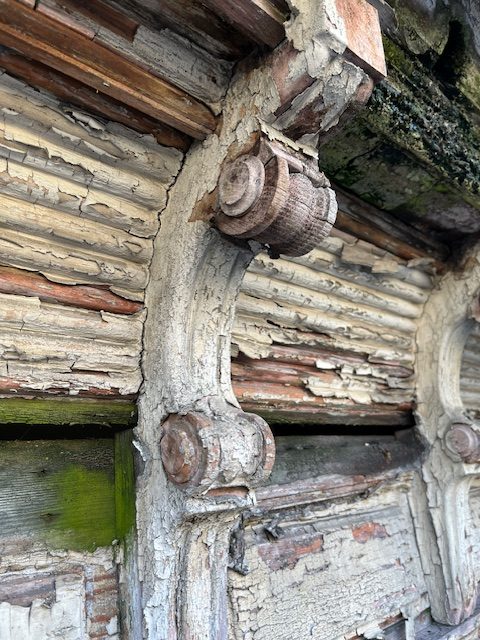
Every layer tells a story. Every period had its “best paint” — its trusted product of the moment. Oil-based, alkyd, acrylic, synthetic resins — each generation painted over the last, and what you’re looking at now is the accumulated history of every choice that came before you.
The lead paint question
Let’s address this directly.
Older paint layers — particularly anything applied before the 1970s and 1980s — may contain lead. This is a real risk, not an invented one. Lead dust from sanding or burning is genuinely hazardous, and the precautions that are now standard practice exist forgood reason.
That said, the conversation around lead paint has sometimes become so loaded with anxiety that craftspeople lose perspective. The risk is real and manageable. Working carefully, using appropriate respiratory protection, and disposing of waste correctly is the professional standard — not an optional extra.
My own approach was always to burn off old paint layers and start from nothing. Back to bare wood, back to the truth of the material. It’s more work. It’s also the only way to know what you’re actually working with.
Is the wood still worth saving?
This is perhaps the most important question — and the one that gets skipped most often.
Not all historic timber is in the same condition. A sheltered door surround in a recessed porch is a different proposition from an exposed cornice that has been shedding water onto an unprotected end grain for thirty years.
Check the end grain. Check the joints. Press firmly with a thumb or a blunt instrument in areas that look suspect. Sound wood resists. Compromised wood gives.
And here’s a question I find myself returning to more and more: is the wood available today of the same quality as what was used originally?
Timber used in 19th and early 20th century construction was often slow-grown, dense, and resinous — oak, pitch pine, solid hardwoods selected for durability. Much of what is available now, even nominally the same species, is faster-grown, less dense, and less naturally resistant to moisture and rot.
This matters when you’re making repair or replacement decisions. The material you’re matching may have properties that modern equivalents simply don’t replicate.
Strip it back — or work with what’s there?
My own position has always been clear: strip back to bare wood and start again. Not because it’s the easiest path — it rarely is — but because it gives you the most honest starting point.
What you find underneath is sometimes a surprise. Sometimes a relief. Occasionally a problem that changes the entire scope of the job.
But you can’t make good decisions about a surface you can’t see.
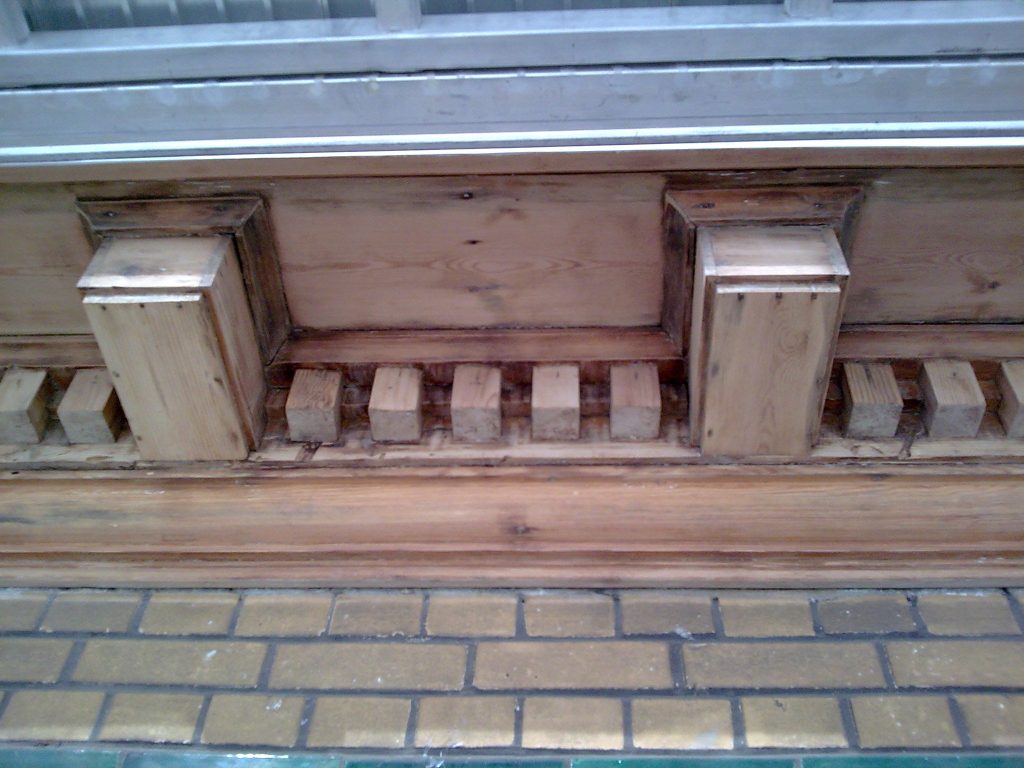
A question to the Guild
What is your approach when you arrive at a historic timber element with multiple paint layers of unknown composition?
Do you strip back completely, or do you work with the existing layers where they’re still sound? And have you noticed a difference in the quality of timber available today compared to what you find in original historic joinery?
The wood has been there for over a century. It deserves a craftsman who reads it before touching it.
RestoreFacade Guild — Part 1 of 4 in the series: Wood on the Historic Façade.