Understanding the logic of maintenance before it becomes restoration
There is a principle built into every well-designed historic facade that most owners never think about — and that most people who work on buildings have never had explained to them clearly.
It is the principle of the sacrificial layer.
A historic facade is not a single material. It is a system of layers, each with a different role, a different lifespan, and a different relationship to the layers around it. Some of those layers are meant to last centuries. Others are meant to wear out in decades — and to wear out first, before the more permanent layers beneath them are reached.
Understanding this changes everything about how you think about maintenance.
The logic of sacrifice
The word sounds dramatic. In practice, it describes something entirely rational.
A wall is built to last. The brick or stone that forms its structure has a potential lifespan measured in centuries — provided it is protected from the things that destroy masonry: water, frost, salt crystallisation, and mechanical stress.
The mortar joint between those bricks is softer than the brick itself. This is not an accident or a compromise. It is a design decision. When the wall moves — as every wall does, with temperature and moisture — the stress has to go somewhere. A mortar that is softer than the brick takes that stress into itself. It cracks, it erodes, it weathers. And then it is replaced. The brick, protected by the mortar’s sacrifice, endures.
The paint on a timber element works the same way. The paint is a barrier — between the wood and the weather, between the wood and moisture, between the wood and the UV radiation that breaks down timber fibres. When the paint fails, the wood beneath it is exposed. Replace the paint before that failure becomes serious, and the wood is preserved indefinitely. Ignore the failing paint long enough, and the wood begins to rot— and what was a painting job becomes a carpentry job, then a structural repair.
The logic is consistent across every element of the facade. The sacrificial layer wears out so that the permanent layer beneath it does not have to.
Paint — the first line of defence
Paint is the most visible and most frequently renewed sacrificial element on any facade. It is also the most frequently misunderstood.
Many owners think of painting as a cosmetic operation — the building looks shabby, so we paint it. The functional reality is the opposite. The building is painted to protect the material beneath, and the appearance is a secondary benefit.
On timber elements — window frames, doors, cornices, shutters — the paint system is the primary defence against moisture penetration. Moisture is what causes timber to rot. A sound, intact paint film prevents moisture from reaching the wood. A failing paint film — cracking, peeling, blistering — is telling you that moisture is getting through. And once moisture has been getting through for a season or two, the wood beneath the paint may already be deteriorating in ways that are invisible from the surface.
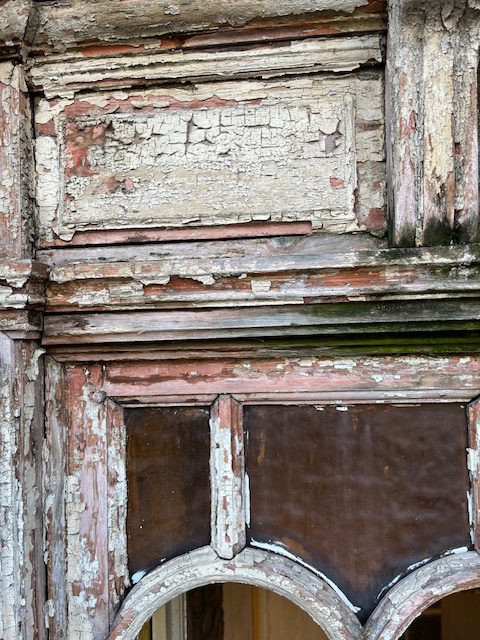
The maintenance interval for painted timber on an exposed historic facade is typically five to ten years — less in very exposed positions, more in sheltered ones. The craftsperson who repaints on schedule, working on sound wood with an intact substrate, is doing a fraction of the work that will be required if the painting is deferred until the wood is visibly damaged.
On render and lime-washed surfaces, the same principle applies. Lime wash is deliberately sacrificial — a thin, breathable coating that protects the render beneath it and can be renewed annually at minimal cost. The buildings that have been lime-washed every year for a century look different from those that have been neglected for decades. The maintenance cost per year is trivial. The restoration cost after decades of neglect is not.
Mortar — softer than the stone for a reason
The mortar in the joints of a historic masonry facade is, as discussed in the mortar blog in this series, designed to be softer than the masonry units it holds together. This is the sacrificial logic applied to the wall itself.
Historic lime mortar weathers. It erodes slowly at the surface, losing depth overdecades as wind, rain, and frost work on it. Eventually — typically after fifty to a hundred years, depending on exposure and mix — the joints need repointing. The mortar is renewed. The brick, which has been protected by the mortar’s gradual sacrifice, is still sound.
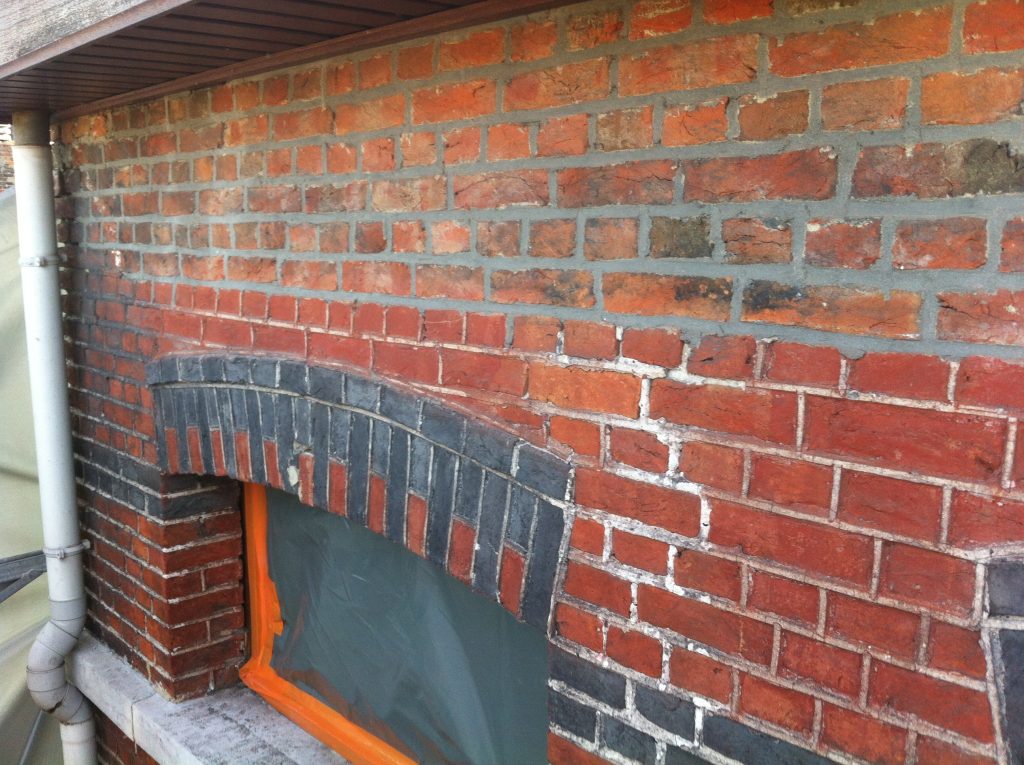
This is how historic masonry is supposed to work. The problem arises when the mortar is replaced with something harder and less permeable than the original — cement mortar, typically — which reverses the sacrificial logic entirely. Now the mortar is harder than the brick. The stress goes into the brick face. The brick spalls and erodes while the mortar sits unchanged in the joints.
The lesson is that repointing is not simply replacing old mortar with new mortar. It is renewing the sacrificial layer with something that continues to perform the sacrificial function. The specification of the new mortar matters as much as the timing of the work.
Lead and zinc — the metal that takes the weather
The lead and zinc elements of a historic facade — gutters, flashings, soakers, roof coverings, ornamental details — are, in their own way, sacrificial. They are the interface between the building and the weather at its most direct: where roof meets wall, where water collects and discharges, where the building’s ability to shed water is most critical.
These elements have finite lifespans. Lead, properly specified and installed, lasts a very long time — many lead flashings on historic buildings are centuries old. Zinc is more vulnerable and has a shorter typical lifespan. Both will eventually fail, and when they do, the consequences spread quickly to the materials beneath and around them.
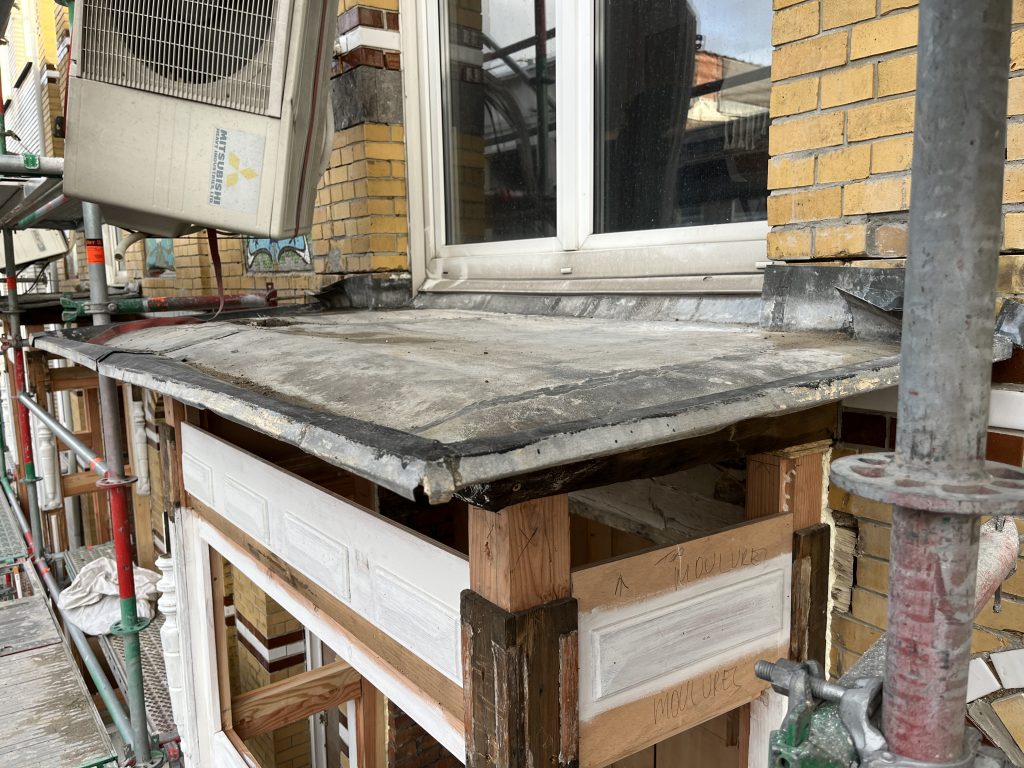
The sacrificial logic here is about timing. A lead or zinc element that is renewed before it fails costs a fraction of what the subsequent water damage repair will cost if it is left until failure. The flashing that is leaking quietly into the wall behind it for a season before anyone notices has already caused damage that the eye cannot yet see.
Timber — the last line before the structure
Timber in a historic facade — window frames, door frames, cornices, structural elements — sits behind the paint film. When the paint is maintained, the timber is protected. When the paint fails and moisture reaches the timber, the timber begins to deteriorate.
Timber deterioration is slow at first and accelerating over time. Early-stage rot can beaddressed with relatively minor intervention — consolidation, localised replacement of small sections, repainting. Late-stage rot, where the structural integrity of the element is compromised, requires wholesale replacement — with all the cost, disruption, and loss of original material that entails.
The sacrificial layer — the paint — exists specifically to prevent the timber from reaching that point. Maintaining the paint is not a cosmetic choice. It is a structural one.
The same goes for steel beams etc. obviously
The maintenance cycle — what responsible ownership looks like
Every element of a historic facade has a natural maintenance interval. Understanding those intervals — and acting within them rather than after them — is the difference between a building that is maintained and a building that deteriorates.
Visual inspection is the starting point and costs nothing. Walk around the building after winter. Look at the paint condition on all timber elements. Look at the mortar joints. Look at the gutters and flashings. Look at the base of the walls. Look at anywhere water might be getting in or pooling. What you are looking for is the early signs of sacrificial layer failure — before that failure has had time to damage the permanent layers beneath.
Cleaning comes next. Organic growth — moss, lichen, algae — holds moisture against the surface and accelerates deterioration. Removing it, carefully and with appropriate methods, is maintenance rather than restoration.
Targeted repair addresses what the inspection reveals — a section of failed pointing, a cracking paint film, a loose flashing — before it becomes something larger.
Scheduled renewal replaces sacrificial elements on a planned cycle rather than waiting for failure. Repaint the timber before the paint fails completely. Repoint the joints before they erode to the point where water is penetrating. Renew the flashings before they leak.
A question to the Guild — and to owners
For craftspeople: have you developed a way of explaining the sacrificial layer principle to clients who are reluctant to spend money on maintenance they cannot immediately see the point of? The argument that prevention costs a fraction of cure is true but not always persuasive. What works?
For owners: when did you last walk around your historic building and look — really look — at the condition of the mortar, the paint, the flashings? If the answer is “I’m not sure,” that is the first maintenance task.
The building is not asking you to save it. It is asking you not to let the sacrificial layers fail without replacement. That is a much smaller ask than it sounds.
RestoreFacade Guild — for the craftspeople and owners who understand that maintenance is not a cost. It is an investment in everything that comes after.