A technical discussion for the Guild — and anyone who owns an Art Nouveau façade
There’s a conversation that doesn’t happen often enough in restoration circles. Not
about what colour to paint historic ironwork. Not about which style to preserve or how to
approach the decorative details.
It’s about what happens before any of that. The preparation. The protection. The
choices that determine whether your work lasts twenty years or starts failing in five.
I want to talk about two of those choices — because I think some common practices in
the industry are doing more harm than good.
Wrought iron is not ordinary steel
This matters more than most people realise.
Wrought iron — the material used in historic Art Nouveau gates, balconies, window
grilles and decorative façade elements — has a significantly higher carbon content than
modern mild steel. It behaves differently. It responds differently to heat. And it reacts
differently to certain protective treatments.
Which brings me to the first point.
Hot-dip galvanising — not the right choice for wrought iron
Hot-dip galvanising is a well-established method for protecting steel. You submerge the
metal in a bath of molten zinc at around 450°C, and the zinc bonds to the surface,
creating a robust protective layer. For modern structural steel, it works very well.
For historic wrought iron, it’s a different story.
The high carbon content in wrought iron reacts unfavourably with the galvanising
process. The zinc layer that forms is less stable, less uniform, and — crucially — more
prone to early corrosion than on regular steel. The very process that’s supposed to
protect the metal can accelerate its deterioration.
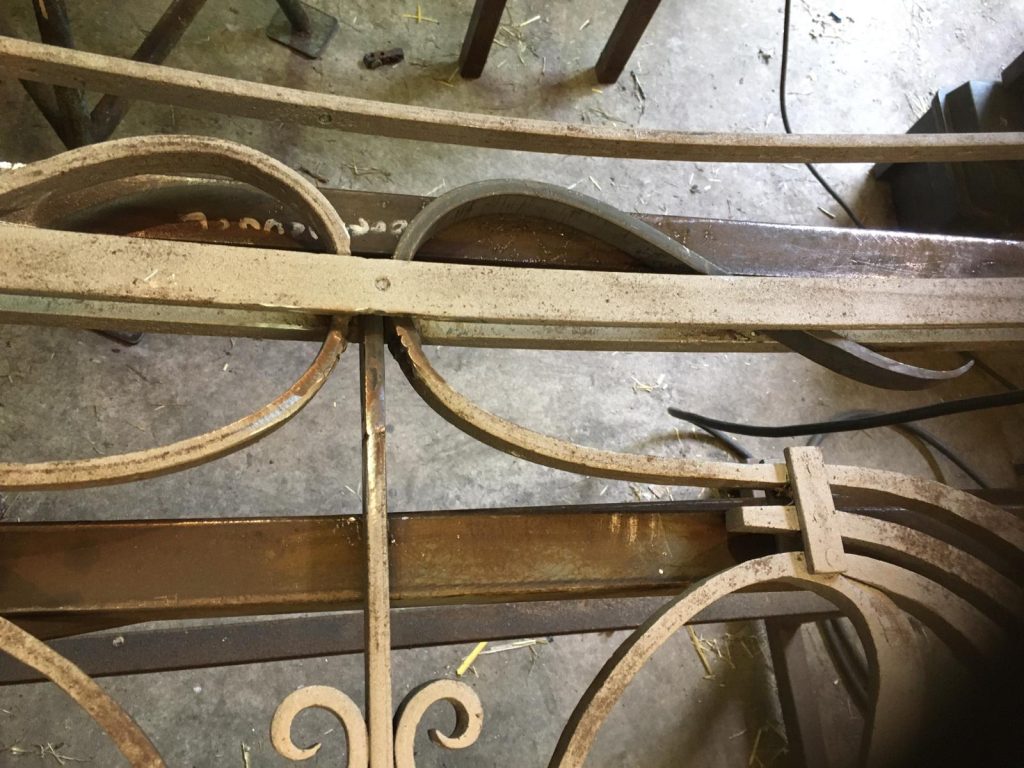
The better alternative: metallising.
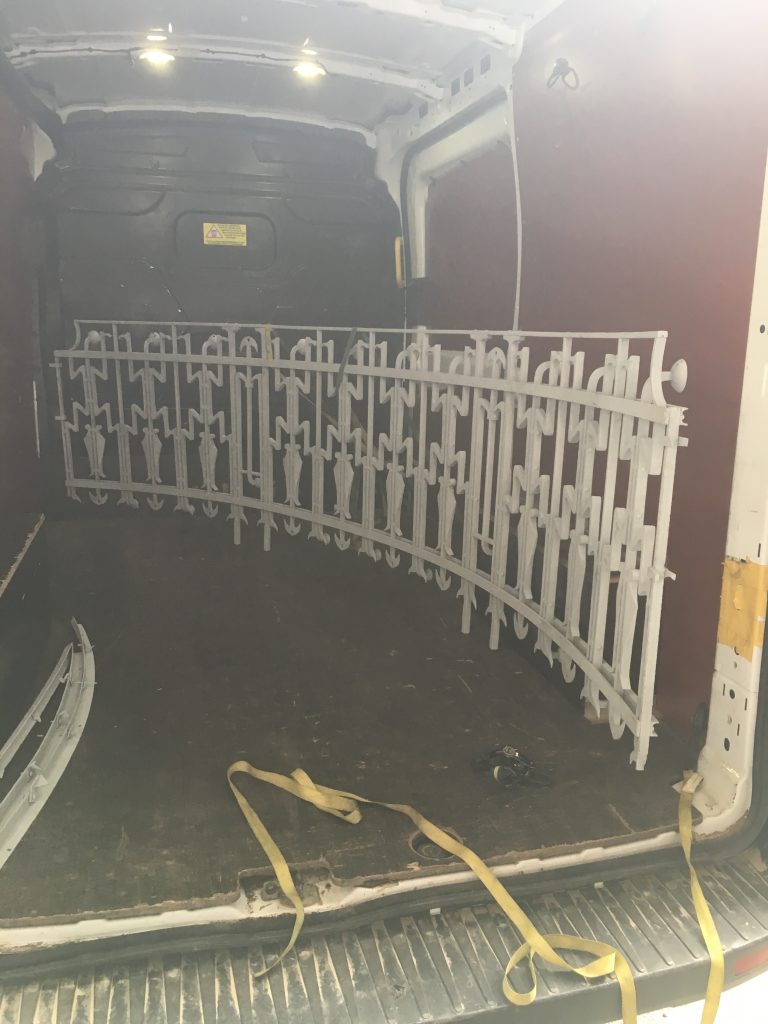
Metallising — also called thermal spray zinc coating — applies zinc to the surface using a
specialised spray gun. The metal is melted and propelled onto the ironwork at much
lower temperatures, without submerging the piece. The result is a protective zinc layer
that adheres well to the surface of wrought iron without the chemical reaction that
makes hot-dip galvanising problematic.
It requires skill and the right equipment. But for historic ironwork, it is simply the more
appropriate choice.
Powder coating — a beautiful problem
Powder coating has become increasingly popular for finishing ironwork. The result is
visually appealing — smooth, even, available in almost any colour. And it’s durable, in the
sense that the coating itself is hard and resistant to impact.
That hardness is also exactly the problem.
Once powder coating is cured, it forms a rigid shell around the metal. For as long as that
shell remains perfectly intact, it protects well. But ironwork expands and contracts with
temperature. It gets knocked, scratched, chipped — as anything does over time. And the
moment a small breach appears in that hard shell, moisture finds its way underneath.
What happens next is predictable. The moisture spreads beneath the coating, corrosion
begins at the metal surface, and the rigid shell — unable to flex or breathe — starts to
lift. Entire sections peel away. What looked perfect begins to fail, often faster than an
uncoated surface would have.
The better alternative: 2K paint, applied by spray.
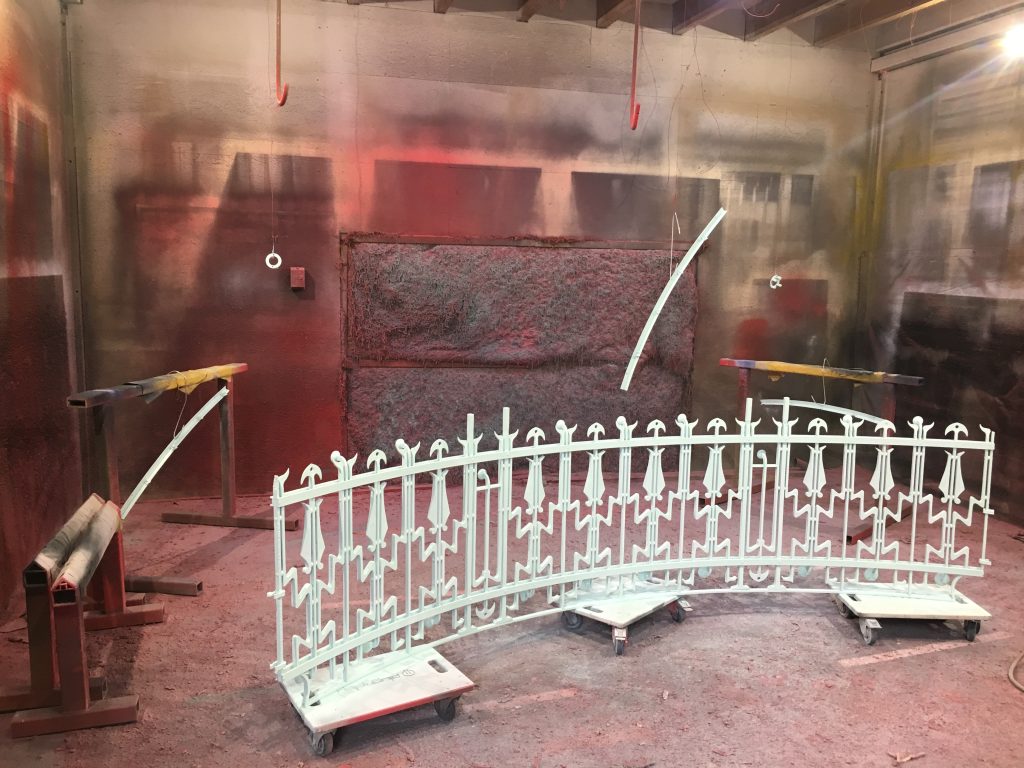
Two-component paint — 2K — bonds differently to the surface. It remains slightly
flexible, moves with the metal, and doesn’t create the same sealed shell effect. When
minor damage occurs, it doesn’t trigger the same catastrophic peeling. Touch-up
repairs are also far more straightforward.
Applied properly by spray, 2K paint gives a finish that is both protective and
sympathetic to the nature of the material it’s covering.
Why does this matter for restoration?
Historic ironwork is irreplaceable. The decorative elements on an Art Nouveau façade —
the curves, the botanical forms, the carefully forged details — cannot simply be
reproduced at reasonable cost if they fail. Protecting them properly is not a luxury, it’s a
responsibility.
Choosing the wrong preparation method or the wrong finish doesn’t just mean extra
maintenance costs down the line. It means accelerated deterioration of something that
has already survived a century or more.
The right choices — metallising over hot-dip galvanising, 2K paint over powder coating
— are not always the easiest or the cheapest. But they are the ones that make sense for
this material, in this context.
A question to the Guild
Have you worked with historic wrought iron? What preparation methods have you used
— or seen used — and what were the results over time?
I’m particularly curious whether others have encountered the powder coating problem
firsthand. It’s one of those things that looks right until it doesn’t.
This is exactly the kind of knowledge that should be shared — not lost.
RestoreFacade Guild — where the details matter, because the details always did.