A personal reflection and a restoration question for the Guild
They stand at crossroads, in the corners of fields, against the walls of farmhouses, at the edges of village squares. Some are no bigger than a letterbox. Others are small buildings in their own right — with a door, a pitched roof, a small window of coloured glass. Most contain an image of the Virgin, a handful of plastic flowers, a candle stub.
They are everywhere in Catholic Europe. And almost nobody talks about them.
I have been looking at them since I was a child. There was one near where I grew up in Willebroek — larger than most, better built than most, the kind that stopped you and made you look twice. It always caught my attention. I didn’t know then that I would spend my working life restoring the buildings around them, or that I would one day build one myself.
What they are — and why they exist
The wayside chapel, the roadside shrine, the small devotional structure — these are among the oldest forms of sacred architecture in Europe. Long before the parish church, before the cathedral, before the organised institutional religion that followed, people marked significant places with small structures of prayer.
A crossroads where a decision had to be made. A spot where someone had died. A field boundary where the community asked for protection of the harvest. A corner of a village where a miracle was said to have occurred. These places needed to be marked, remembered, and maintained — and the small chapel or shrine was the answer.
With the spread of Christianity across Europe, these pre-existing devotional habits were absorbed and transformed. The figures of local saints replaced older spirits. The cross replaced older symbols. But the instinct — to mark a place, to create a point of prayer that was close, accessible, belonging to the community rather than to the institution — remained.
The names they go by
Every country has its own tradition and its own vocabulary.
In Belgium and the Netherlands, the small built shrine is a kapelletje — a little chapel. The word covers everything from a simple niche in a wall to a freestanding structure with a pitched roof and a lockable door. Along Flemish country roads, they appear at intervals that suggest a walking pace — a moment of prayer for the traveller, a marker for the community.
In France, the equivalent is the oratoire or the croix de chemin — the wayside cross. France has tens of thousands of them, protected under heritage legislation as elements of the rural landscape, many of them centuries old.
In Italy, the edicola votiva or capitello appears on almost every rural road and in many urban streets — a niche, a small arch, a miniature facade with a image of the Madonna or a local saint. In the Veneto and Friuli regions, the capitello tradition is particularly rich, with small structures of considerable architectural quality.
In Portugal, the alminhas — shrines for the souls of the dead — mark places of tragedy and memory along roads and at crossroads. They are among the most emotionally charged of all the wayside structures, and they are, in many regions, in serious need of restoration attention.
In Spain, the humilladero and the ermita — the small hermitage chapel — appear in the landscape, often at high points with wide views, often with a history that goes back to the medieval period.
In the UK, the tradition of wayside shrines was largely broken by the Reformation in the 16th century. What survived — and there is more than is generally recognised — tends to be found in areas that remained Catholic longer, or in the revival of devotional architecture in the 19th century.
The restoration question
Who restores them?
This is not a simple question. The ownership of wayside chapels and roadside shrines is often unclear — they may belong to the municipality, to the local parish, to a private family that erected them generations ago, or to nobody in particular. The maintenance has traditionally fallen to the community, to the women of the neighbourhood who kept the candles burning and the flowers fresh, to the farmer on whose land they stand.
As rural communities have aged and thinned, that informal maintenance network has weakened. Many wayside chapels across Europe are in poor condition — rendered surfaces cracking, roofs leaking, decorative elements lost, the whole structure slowly returning to the earth it was built from.
The specific restoration challenges are familiar to anyone who has worked on historic buildings, just at a smaller scale. Lime render that has failed. Small moulded cornices that have lost their profile. Stone elements — a small cross, a carved base, a decorative panel — that have weathered beyond recognition. Painted surfaces inside and out. Sometimes small areas of mosaic or coloured tile that need specialist attention.
The scale is modest. The craft knowledge required is not. And the importance to the communities that still gather around these structures — for the feast days, for the candles at Christmas, for the informal acts of prayer that continue even when the formal religious observance has faded — is genuine.
A personal story — building one for television
In 2016 and 2017, I was part of the team that built the sets for De Bende van Jan de Lichte — the Flemish television series about the 18th century outlaw Jan de Lichte, filmed primarily in the Kluisbos forest in Kluisbergen.
Among the structures we built for the production was a small chapel — het kapelletje van den bos, the chapel of the woods. It was designed and built to serve the needs of the production, to look right in the landscape of 18th century Flanders, to read as a genuine piece of the world that Jan de Lichte moved through.
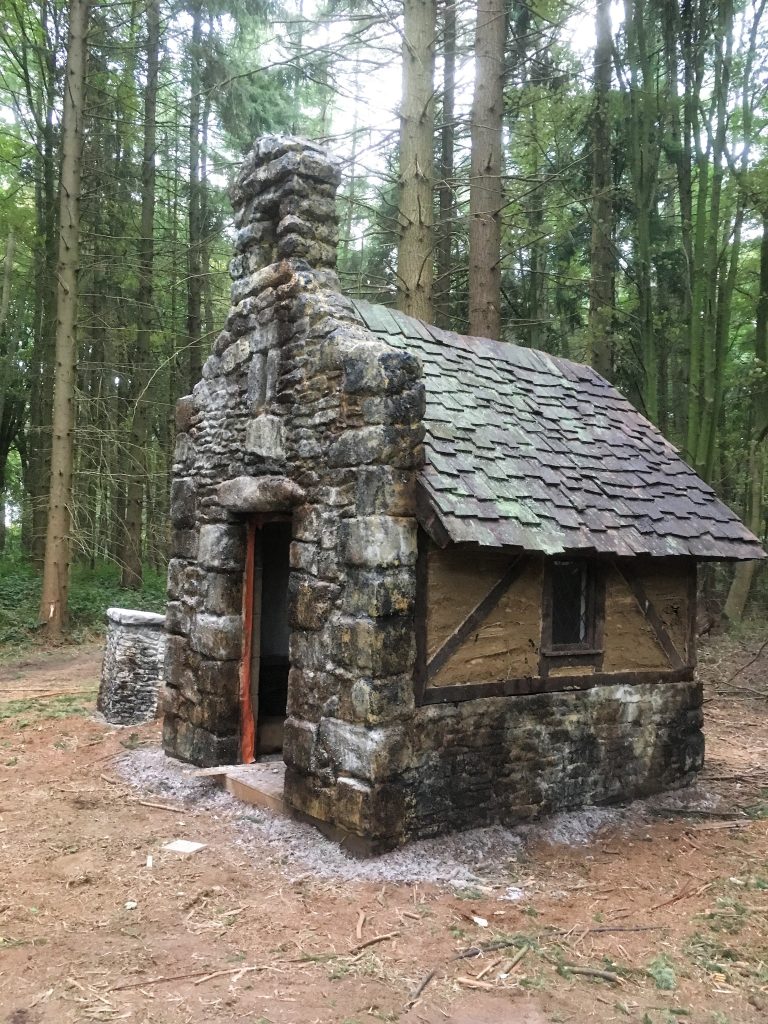
It looked right. It felt right. And when the production was finished and the sets were dismantled, the decision was made to leave the chapel standing. It had become part of the place.
I don’t know what state it is in now. A structure built for a film production is not built to last — the materials are chosen for appearance, not longevity, and the maintenance that keeps a real chapel standing does not happen for a film set. But the fact that it was left, that it earned its place in that forest, is something I think about.
There was also a second structure we built nearby — the herberg De Grote Honger, the inn where Jan de Lichte and his band sheltered. That one did not survive. It was destroyed by fire — whether deliberately or by accident, I cannot say for certain. A reminder that not everything we build outlasts our intentions for it.
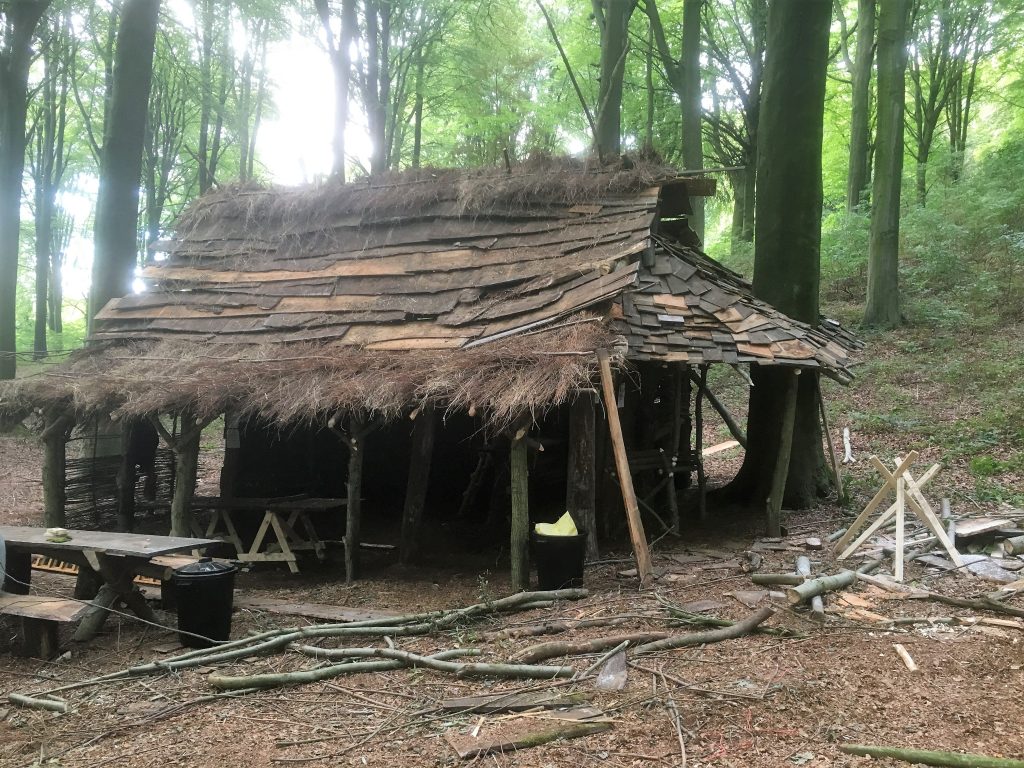
The chapel near where I grew up
The kapelletje of Willebroek — the one I mentioned at the beginning, the one that always caught my eye as a child — is het kapelletje van den bos on the Oude Dendermondsestraat. It is larger and better built than most roadside shrines, a proper small building with architectural pretension, the kind of structure that someone built with care and with the intention that it should last.
It appears in the heritage inventory of Willebroek, photographed in 1993. Whether it has been maintained well since then, whether it still stands in something close to its original condition, I do not know for certain. But the fact that someone thought it worth documenting tells you something about its quality
A question to the Guild — and to anyone who has stood in front of one of these structures
Have you ever worked on a wayside chapel or a roadside shrine? The specific restoration challenges — lime render at small scale, miniature mouldings, small areas of decorative tile or mosaic, the structural issues of a small building that has been neglected for decades — seem like fertile ground for Guild discussion.
And has anyone encountered the ownership question in practice? Who paid for the work, and how was the decision made to restore rather than let it go?
These structures are not grand monuments. They are not listed buildings in most cases. Nobody is going to write a conservation management plan for a roadside shrine. But they are part of the landscape of historic Europe in a way that is quietly irreplaceable — and when they go, they go without anyone quite noticing until they are already gone.
The smallest sacred buildings deserve the same care as the grandest. Perhaps more, because there is nobody else looking out for them.
RestoreFacade Guild — for the craftspeople who notice what others walk past.